Vitamin D Supplementation Basics for Adults: Answers to Common Questions
Picture standing in the pharmacy aisle, staring at a shelf lined with bottles labeled D3, D2, 1000 IU, 25 mcg, gummies, drops—and no clear sense of which one, if any, actually applies to you. That moment of uncertainty is exactly where vitamin d supplementation basics for adults become useful, because the short answer is that most of these products cover the same underlying nutrient, just packaged differently, and whether you need one at all usually depends on your sun exposure, diet, and a simple blood test rather than guesswork at the shelf.
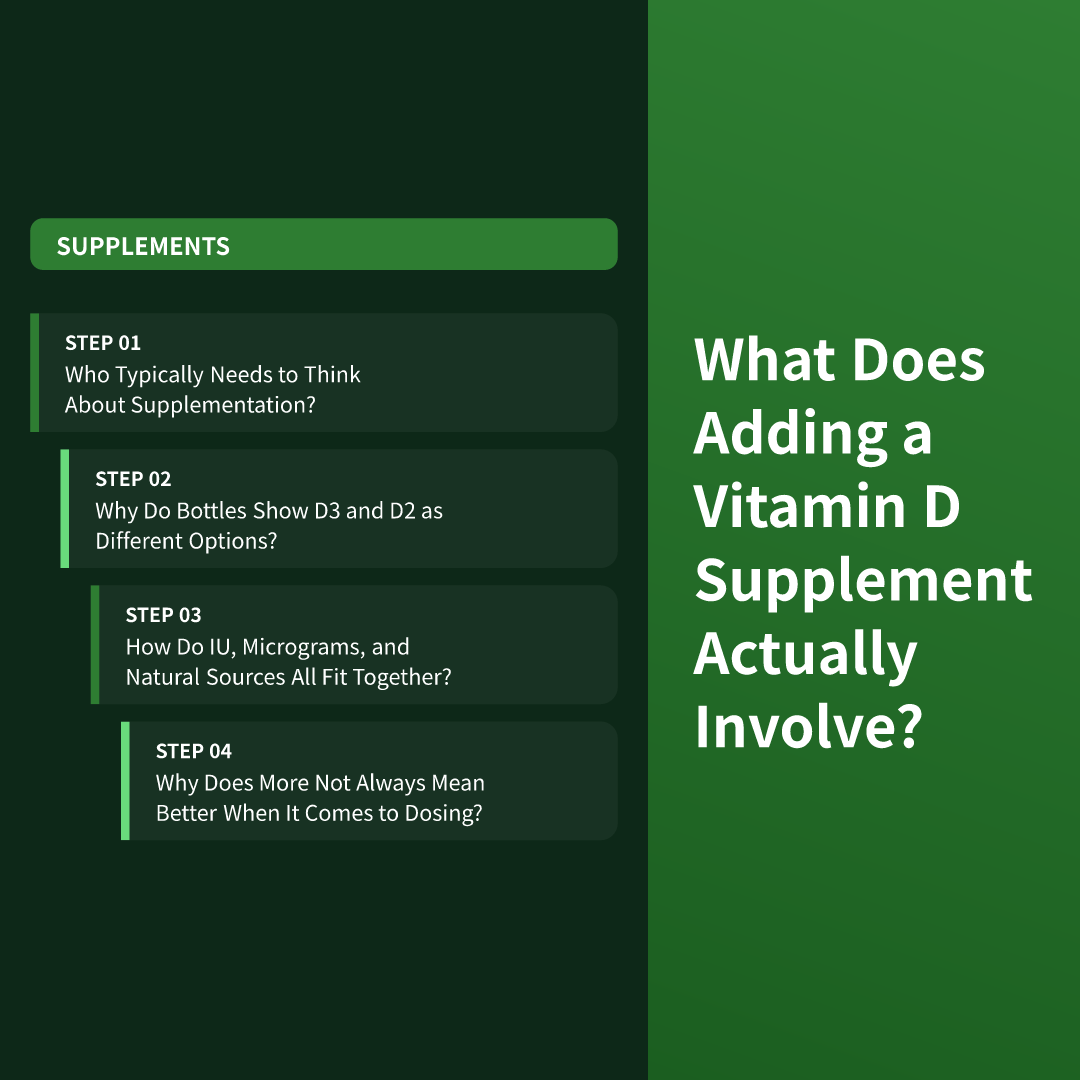
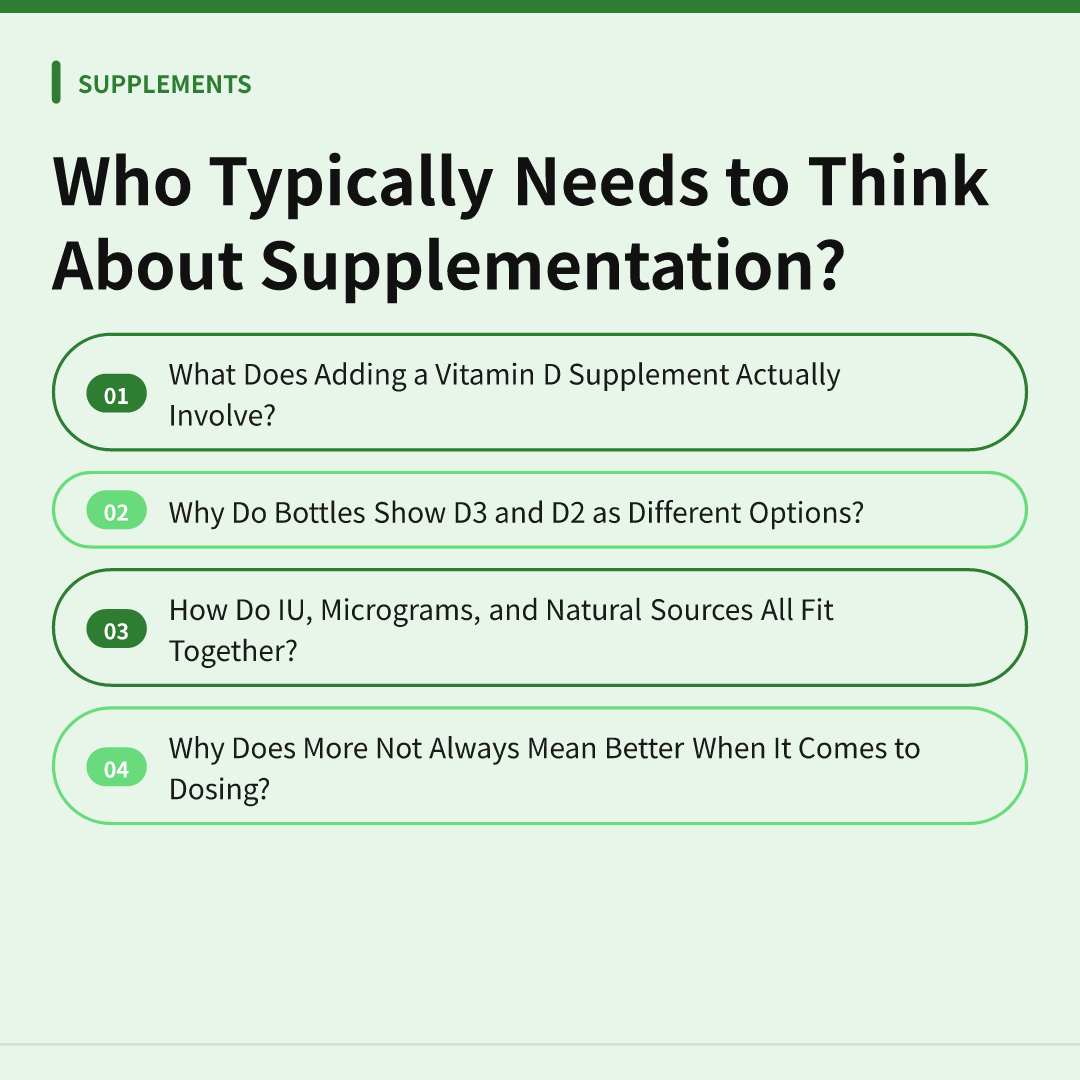
What Does Adding a Vitamin D Supplement Actually Involve?
Taking a vitamin D supplement means adding a manufactured form of the nutrient—almost always D3 or D2—to fill a gap that sunlight and food don’t fully cover. Vitamin D itself is fat-soluble, meaning it dissolves in fat and gets stored in body tissue rather than flushed out quickly like a water-soluble vitamin would be.
According to the National Institutes of Health Office of Dietary Supplements, this nutrient helps the body absorb calcium and supports normal bone function. The exception worth noting: supplementation isn’t one fixed routine for everyone, since the form, amount, and duration are typically decided by a pharmacist or provider based on individual test results and health history.
Who Typically Needs to Think About Supplementation?
Supplementation tends to come up in a handful of recurring situations rather than as a default habit for every adult. People who spend most of their time indoors, live through long winters, or consistently cover their skin outdoors often produce less vitamin D naturally, and since only a small number of foods contain meaningful amounts, limited dietary variety can compound that gap.
Age is another factor that surfaces in routine checkups, since skin’s ability to produce vitamin D from sunlight can shift over time. The exception here is health conditions affecting fat absorption, which can interfere with how efficiently the body uses vitamin D regardless of age or sun exposure—this is usually why a provider suggests blood testing before recommending anything.
A blood test is typically the only reliable way to know whether vitamin D levels are actually low—guessing based on symptoms alone isn’t a substitute for lab work ordered by a healthcare provider.
Why Do Bottles Show D3 and D2 as Different Options?
Supplements generally come in two forms: D3 (cholecalciferol), which resembles what skin produces from sunlight, and D2 (ergocalciferol), often sourced from plants or fungi. The body processes these two forms somewhat differently, which is the main reason they aren’t treated as fully interchangeable.
The exception is that for many otherwise healthy adults, either form can reasonably meet basic needs—the distinction matters more in specific clinical situations, which is exactly why a pharmacist might steer someone toward one form over the other based on personal circumstances.
How Do IU, Micrograms, and Natural Sources All Fit Together?
Labels list amounts in IU (international units) or mcg (micrograms), and seeing both on different products can feel like comparing apples and oranges. Rather than doing the conversion math yourself, it’s generally more practical to bring the bottle—or a photo of the label—to a pharmacist when discussing what fits your situation.
Sunlight, food, and supplements can be thought of as three taps feeding the same bucket—all three contribute to the same overall vitamin D pool in the body. If one tap runs low, the others don’t automatically need to compensate, but a bucket that stays noticeably empty over time is what prompts a provider to look closer; no single source is inherently “better” on its own.
Why Does More Not Always Mean Better When It Comes to Dosing?
Because vitamin D is fat-soluble and stored in the body rather than excreted quickly, assuming that a larger dose is automatically more helpful doesn’t hold up the way it might with a water-soluble vitamin. This is a large part of why unsupervised high-dose supplementation is generally discouraged without guidance from a healthcare provider.
The exception is when unusual symptoms appear after starting a supplement—persistent nausea or unusual fatigue, for example—which is a signal to stop and check in with a provider rather than waiting it out. People managing kidney conditions, parathyroid issues, or those already taking multiple medications, along with pregnant or breastfeeding individuals, should generally loop in a pharmacist before adding vitamin D, since needs and interactions can differ from general adult guidance.
Frequently Asked Questions
Can I just start taking a vitamin D supplement without getting tested first?
You technically can, since these products are sold over the counter, but a blood test is what actually tells you whether your levels are low in the first place. Starting without that information means guessing at both whether you need it and how much.
Does taking vitamin D mean I also need a calcium supplement?
Not necessarily—the two nutrients interact in the body and are sometimes sold together, but they’re distinct with different jobs. Taking one doesn’t automatically make the other unnecessary or excessive; a pharmacist can clarify how combination products are typically paired.
Are vitamin D supplements regulated the same way as prescription medications?
No, supplements aren’t reviewed by regulators the same way prescription drugs are, which is why choosing reputable brands matters. Mentioning any supplement use during medical appointments also helps your care team keep the full picture visible.
Is vitamin D basically an immune booster?
Not in the way it’s often marketed—its studied role is more specifically tied to calcium regulation and bone-related processes rather than broad immune enhancement. Treating it as a general energy or immunity “fix” is one of the more common misunderstandings around this nutrient.
Disclaimer: This article is for informational purposes only and is not a substitute for professional medical advice, diagnosis, or treatment. Please consult a licensed professional for personal health decisions.