Daily Habits That Support Mental Wellbeing: Start Small
If you’ve ever tried to overhaul your entire routine at once—meditation at dawn, a gratitude journal, ten thousand steps, a strict sleep schedule, and cutting out screens after dinner—you already know how this usually ends. Daily habits that support mental wellbeing don’t need to be a long checklist. In fact, trying to do everything at once is one of the most common reasons people quit within a week or two. This piece looks at what’s genuinely worth prioritizing, what can wait, and what you probably don’t need to force at all.
None of this replaces care from a qualified mental health professional. Think of it as a starting framework for everyday maintenance, not a treatment plan.
The Habits Most Worth Your Limited Energy
Not every wellness habit carries equal weight. If you’re only able to hold onto one or two things right now, these tend to offer the most return for the effort involved, based on general guidance from health organizations rather than any single dramatic claim.
Protecting a Consistent Sleep Rhythm
Going to bed and waking up around similar times, even on weekends, is often described as one of the more foundational habits for emotional regulation. Sleep quality affects mood, focus, and how well the body handles stress the following day. This doesn’t mean chasing a “perfect” number of hours—it means noticing your own pattern and trying to keep it reasonably steady rather than swinging wildly between late nights and catch-up sleep.
For general background on sleep and health, the CDC’s sleep resources offer a credible starting point. If sleep problems persist despite steady routines, that’s a signal worth bringing to a doctor rather than trying to fix through willpower alone.
Some Form of Daily Movement
You don’t need a gym membership or a structured workout plan for movement to matter. A short walk, stretching, or any activity that gets your body moving a little each day is commonly associated with steadier mood and lower stress levels in general health guidance. The key word is some—consistency in small amounts tends to matter more than intensity in occasional bursts.
This is one of those habits where the gap between “doing a little” and “doing nothing” seems to matter more than the gap between “a little” and “a lot.” If a ten-minute walk is realistic today and an hour isn’t, the ten minutes still counts.
One Small Point of Human Connection
A short conversation, a text to a friend, or a few minutes with a family member can act as a quiet anchor on days that otherwise feel isolating. Isolation is frequently discussed as a factor that can worsen low mood over time, so even minimal, low-effort contact is generally considered worthwhile. This doesn’t require deep or lengthy interactions—brief and regular tends to be more sustainable than rare and intense.
If you can only manage one thing today, pick whichever of these three feels the least overwhelming—not the one that sounds most impressive.
how sleep affects mental health
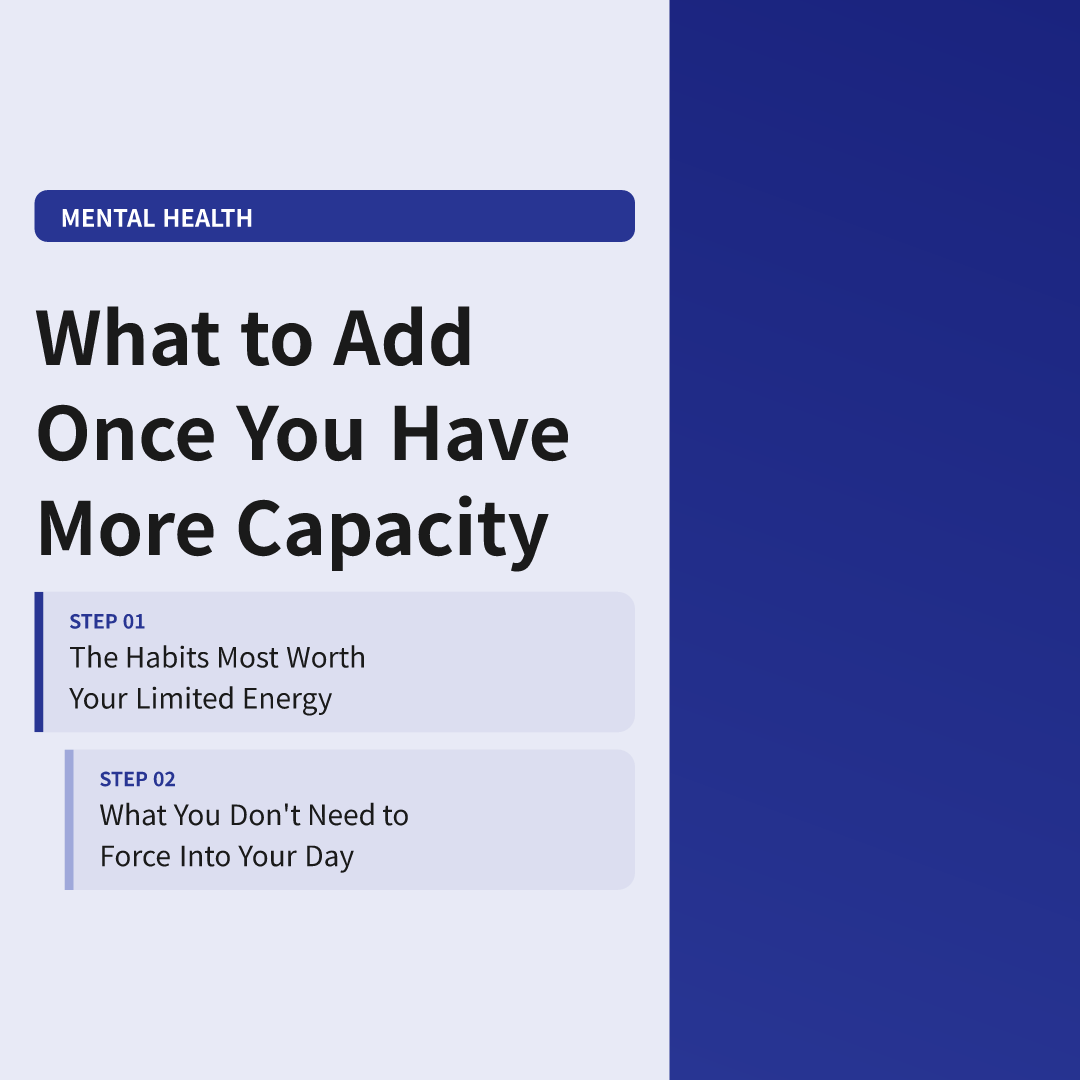
What to Add Once You Have More Capacity
Once the basics above feel steady rather than like extra pressure, there are additional habits that can layer on further support. These aren’t essential starting points, but they can add value for people who have some bandwidth left over.
Brief Mindfulness or Breathing Pauses
A few minutes of slow breathing or a short mindfulness exercise during a stressful moment can help some people create a bit of distance from anxious thoughts. This isn’t a fix for underlying anxiety disorders, and results vary a lot from person to person—some find it genuinely calming, others find it doesn’t do much at all, and that’s a normal range of response.
Writing Down a Few Thoughts
Journaling, even just a couple of sentences about how the day went, can help some people notice patterns in mood or triggers over time. It works best as a low-pressure habit rather than a performance—there’s no requirement to write daily, write a certain amount, or write anything “insightful.”
Paying Attention to Food and Hydration Patterns
Skipping meals or going long stretches without water can contribute to irritability and low energy for many people, which can indirectly affect mood. This isn’t about following a specific diet—it’s simply noticing whether your eating pattern is leaving you running on empty most of the day.
Setting Rough Boundaries Around News and Social Media
Constant exposure to distressing news or comparison-heavy social feeds is something many people notice affects their mood, even if the effect is hard to measure precisely. Setting loose boundaries—rather than strict bans—around when and how much you scroll can be a reasonable middle ground for people who notice this pattern in themselves.
What You Don’t Need to Force Into Your Day
Part of supporting mental wellbeing is recognizing which popular habits are optional rather than mandatory. Carrying guilt over skipping these doesn’t help anyone.
- A perfect, unbroken streak of any habit. Missing a day of meditation, journaling, or exercise doesn’t undo previous progress. Habits that survive missed days tend to be more sustainable than ones built on all-or-nothing thinking.
- An elaborate morning or evening routine. Multi-step routines with a dozen components can look appealing online, but for many people they add pressure rather than calm. A simple, short routine is often more realistic to maintain.
- Eliminating stress entirely. Some stress is a normal part of daily life and even useful in small doses. The goal of these habits isn’t a stress-free existence—it’s building a bit more resilience and recovery time around ordinary stress.
- Forcing positivity or suppressing difficult emotions. Gratitude practices and positive thinking can be helpful for some people, but they aren’t meant to replace acknowledging genuine sadness, frustration, or grief when it shows up.
- Tracking every habit in detail. Complex trackers, apps, and spreadsheets can become their own source of stress. A simple mental note or short list is usually enough.
If a particular habit consistently feels like a chore rather than a support, it’s fair to drop it and focus energy elsewhere. Daily habits that support mental wellbeing are meant to lighten the load, not add another obligation to manage.
Common Questions About Building These Habits
Can small daily habits really make a meaningful difference?
For many people, small and consistent habits—steady sleep, some movement, basic connection—do appear to support general mood and stress resilience over time, according to general public health guidance. That said, habits alone aren’t a treatment for diagnosed conditions like depression or anxiety disorders, and they work differently for different people.
What happens if I miss a few days or fall out of routine entirely?
Falling out of a routine is common and doesn’t erase whatever benefit the habit provided while you kept it up. The most useful approach is usually to restart with the smallest version of the habit rather than trying to make up for lost time all at once.
When should I look into professional support instead of relying on habits alone?
If low mood, anxiety, sleep problems, or loss of interest in daily life are lasting for weeks, interfering with work or relationships, or come with thoughts of self-harm, that’s a signal to reach out to a doctor, therapist, or a crisis line rather than relying on self-directed habits. Daily routines can support general wellbeing, but they aren’t a substitute for professional evaluation when symptoms are persistent or severe. In the United States, the 988 Suicide & Crisis Lifeline is available for immediate support.
How long before I actually notice a difference?
This varies quite a bit from person to person, and there’s no fixed timeline that applies to everyone. Some people notice small shifts in mood or energy within a couple of weeks of steadier sleep and movement, while for others it takes longer, or the effect is harder to pin down against everything else going on in life. Patience and consistency tend to matter more than any specific number of days, and if nothing changes after a reasonable stretch of steady effort, that’s worth discussing with a healthcare provider rather than assuming the habits themselves have failed.
Disclaimer: This article is for informational purposes only and is not a substitute for professional medical advice, diagnosis, or treatment. Please consult a licensed professional for personal health decisions.