How to Build a Simple Meditation Habit That Lasts
The simplest way to build a meditation habit is to keep it small, attach it to something you already do, and let it be imperfect. Most people don't quit because meditation is too hard. They quit because they tried to do everything at once: a perfect cushion, a long session, a silent mind, a flawless streak. This guide sticks to the minimum that tends to matter, then adds extras only if you feel like it.
A quick note on scope: this is general wellness information written by an editor, not medical advice. Meditation is often described as a way to support relaxation and attention, but it is not a treatment for any condition, and results vary from person to person.
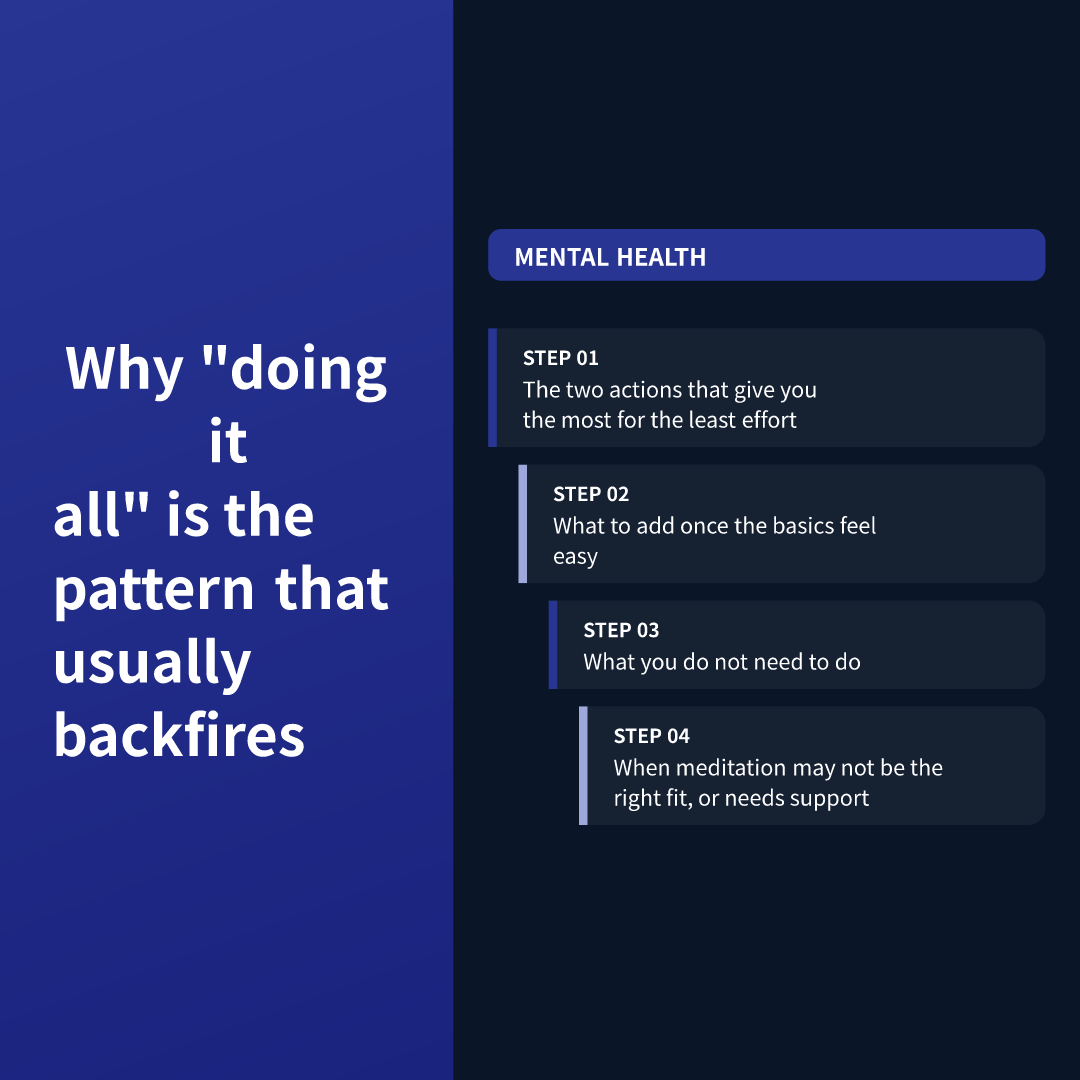
Why "doing it all" is the pattern that usually backfires
Picture the typical start. You read about meditation, buy an app, set a daily alarm, clear a corner of your room, and plan a long morning session. For a few days it feels purposeful. Then a busy morning arrives, you miss one day, and the whole plan starts to feel like a failure.
Habit researchers and behavior-change writers commonly point out that routines tend to stick when they are easy to start and easy to repeat. The bar you set on a motivated day is rarely the bar you can meet on a tired one. So the goal here is not an ideal practice. It is a practice small enough that you can still do it on a bad day.
Another trap is judging a session by how calm you felt. A wandering mind is a normal part of meditation, not proof that you are doing it wrong. According to the National Center for Complementary and Integrative Health (NCCIH), mindfulness and meditation practices generally involve paying attention on purpose, and noticing that your attention drifted is part of the practice itself.
The two actions that give you the most for the least effort
If you only do two things, make them these. They cost almost nothing, and they address the main reasons habits fall apart: friction and forgetting.
1. Keep each session very short and very easy
Start with a session so brief it almost feels silly. A couple of minutes is plenty to begin with, and many people find that a small, repeatable amount is easier to keep than an ambitious one. The point of the early weeks is not depth. It is showing up often enough that sitting down becomes familiar.
A simple form is to sit comfortably, let your attention rest on the feeling of breathing, and gently return to it each time your mind wanders. That return is the whole exercise. You are not trying to stop thoughts, only to notice them and come back.
What to expect: short sessions may make it easier to keep going, and some people find they feel a bit more settled afterward. The limit: a few minutes will not transform your day, and it is not a substitute for care if you are dealing with persistent stress, low mood, or anxiety.
2. Tie it to something you already do
The second high-value move is anchoring. Instead of relying on willpower or a floating "sometime today," link meditation to an existing routine, such as right after brushing your teeth, after your first cup of coffee or tea, or when you sit down on the bus or train. Behavior-change writers often call this habit stacking, and the logic is simple: the old habit becomes the reminder for the new one.
Choose an anchor that happens reliably, even on chaotic days. If your mornings are unpredictable, an evening anchor may work better. There is no universally right time, and the best slot is usually the one you will actually keep.
What to expect: fewer decisions and less forgetting. The limit: if your anchor routine changes, say you switch shifts or travel, you may need to pick a new one. That is normal, not a setback.
What to add once the basics feel easy
These are optional. Add one at a time, and only when the first two feel almost automatic. If you add them too early, you may recreate the overload that ends most attempts.
Gently lengthen the session
Once short sessions feel routine, some people like to sit a little longer. There is no required number, and nothing says you must increase. If a longer session feels restless or unpleasant, going back to the shorter one is a perfectly reasonable choice.
Try a guided recording
Guided meditations, offered through apps, libraries, or free online recordings, can give you something to follow, which some beginners find less intimidating than silence. Free options are widely available, so there is rarely a need to pay for anything up front. Different voices and styles suit different people, so it is fine to try a few and drop the ones that grate on you.
Notice how you feel, loosely
A short note afterward, even a single word, can help you see patterns over time. Keep it casual. The aim is curiosity, not grading yourself. If tracking starts to feel like homework, stop doing it.
Explore other styles later
Breath focus is only one approach. Others include body scans, walking meditation, and kindness-focused practices. The NCCIH describes meditation as a broad group of practices rather than a single technique, so if one style does not suit you, that does not mean meditation is not for you.
What you do not need to do
This is the part that often removes the most pressure. Many common beliefs about meditation are optional extras, not requirements.
- You do not need a special space. A chair, a couch corner, or a spot on the floor is enough. Comfort matters more than appearance.
- You do not need special gear. Cushions, timers, and apps can be nice, but none are required to begin.
- You do not need to empty your mind. A busy mind is typical. Noticing and returning is the practice.
- You do not need to sit cross-legged. Sitting in a chair, lying down, or even walking slowly can work, depending on what is comfortable for you.
- You do not need a perfect streak. Missing a day is not a reset to zero. Picking it back up is the habit.
- You do not need to feel calm every time. Some sessions will feel scattered, and that is a normal part of the experience.
- You do not need to follow a spiritual tradition. Many people practice in a purely secular way, though others find meaning in a faith or philosophy. Both are fine.
If a rule makes you dread sitting down, it is probably not essential. What is useful can be kept, and the rest can be set aside.
When meditation may not be the right fit, or needs support
Meditation is widely used and often described as gentle, but it is not right for everyone at every moment. Reactions vary from person to person. Some people find that sitting quietly with their thoughts brings up uncomfortable feelings, memories, or heightened anxiety. If that happens, it is reasonable to stop, try a shorter or more active style, or talk with a qualified professional before continuing.
Consider reaching out to a licensed mental health professional or your regular healthcare provider if you have a history of trauma, ongoing depression or anxiety, or other mental health concerns, and you want to know whether and how meditation might fit alongside your care. The NCCIH notes in its general guidance that meditation is not a replacement for conventional medical care, and that it is worth telling your healthcare providers about any health approaches you use.
If you feel persistently hopeless, overwhelmed, or unsafe, or are thinking about harming yourself, please seek help right away. In the United States, you can call or text 988 to reach the Suicide and Crisis Lifeline, and if you are elsewhere, local emergency services or a crisis line can help. Meditation is not meant to handle a crisis on its own.
Frequently asked questions
What if I keep falling asleep while I meditate?
Dozing off is common, especially if you are tired or lying down. Some people find that sitting upright or meditating at a different time of day helps. If you are regularly exhausted, it may be worth considering your overall sleep and mentioning persistent tiredness to a healthcare professional.
Is it a problem if I miss several days in a row?
No, a gap does not erase what you have built. Habits generally survive interruptions better when you return without self-criticism, so a very short session is often a gentler way back in than trying to make up for lost time.
Should I use an app or meditate on my own?
Either can work, and it mostly comes down to preference. Some people like the structure and voice of a guided recording, while others prefer the simplicity of silence. Trying both for a while can show you which feels easier to keep up.
Why do some people notice changes sooner than others?
The timing of any change differs widely, and there is no standard schedule to measure yourself against. Factors such as stress levels, sleep, life circumstances, what you expect from meditation, and which style you practice can all shape what you notice and when. Some people sense a subtle shift in how they handle a hectic day, others notice it mainly in hindsight, and some find that the quiet moment itself is the benefit. Because the experience is so personal, a more useful measure than a deadline is whether the practice feels sustainable and worth returning to, and that is the heart of how to build a simple meditation habit that suits your own life.
Disclaimer: This article is for informational purposes only and is not a substitute for professional medical advice, diagnosis, or treatment. Please consult a licensed professional for personal health decisions.