How to Handle Negative Self Talk Based on Its Cause
The same harsh inner voice can come from very different places, and that is why advice about how to handle negative self talk works for some people and falls flat for others. A voice that grew out of perfectionism needs a different response than one that flares up during burnout or one tied to long-standing painful experiences. Matching the approach to the source tends to save a lot of wasted effort. This article walks through common causes, how to tell them apart, and what generally helps, while being honest about the limits of self-help.
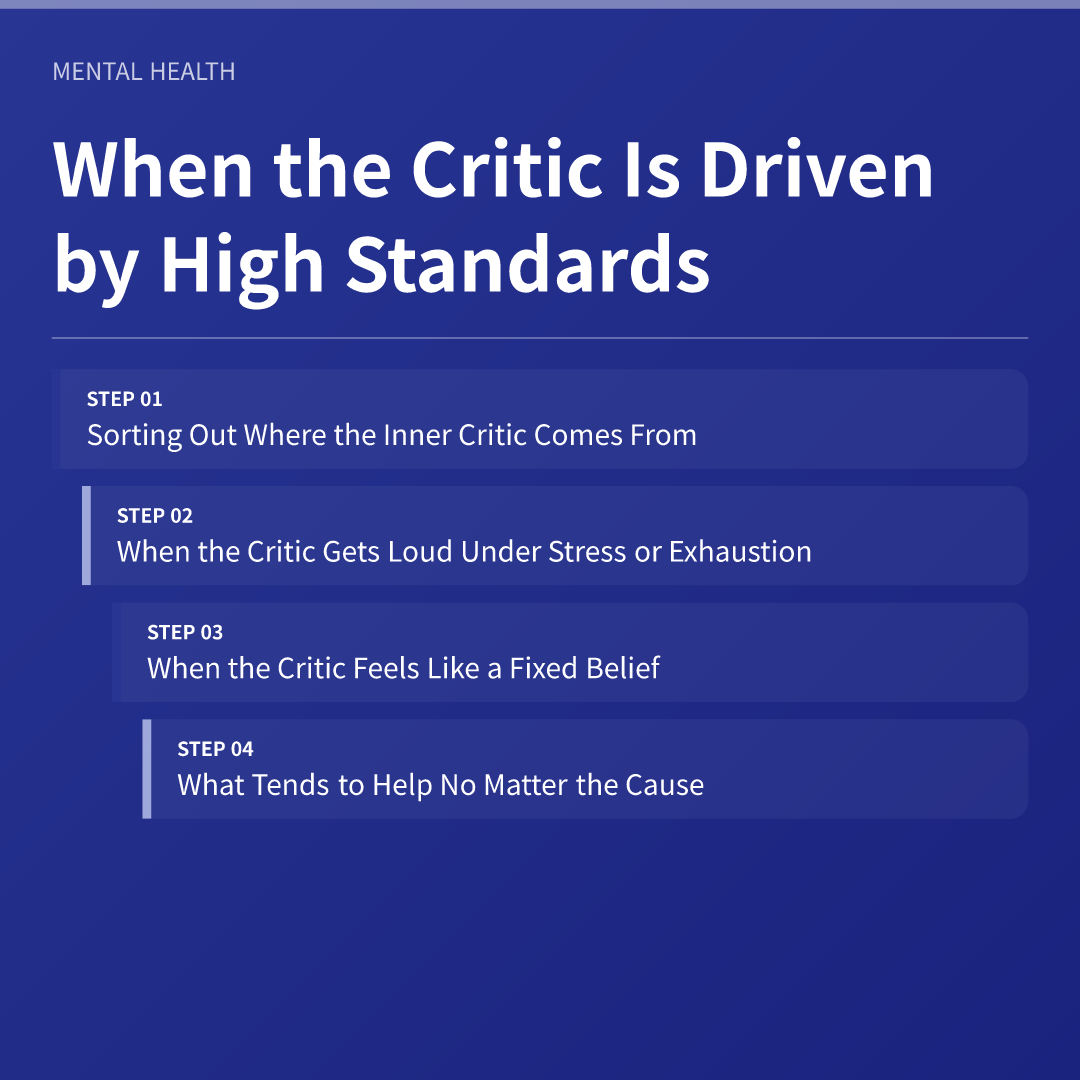
Sorting Out Where the Inner Critic Comes From

Almost everyone has an inner critic at times. Psychologists often describe self-critical thoughts as a habit of the mind, one that can be shaped by upbringing, stress, past experiences, and current circumstances. Because the causes overlap, no single label fits everyone, and the categories below are a rough map rather than a diagnosis.
Three patterns come up often in general mental health education:
- Standards-driven criticism: the voice pushes you to be better and treats every gap as a failure.
- Stress-driven criticism: the voice gets louder when you are tired, overloaded, or under pressure, and quieter when life calms down.
- Deep-rooted criticism: the voice feels like a fixed belief about who you are, often tied to earlier life experiences, and it shows up in many settings.
Some people fit more than one pattern, and that is normal. The sections below explain how to check which one seems closest and what tends to help in each case.
When the Critic Is Driven by High Standards
How to tell if this is your pattern
Notice what the voice says after you do something well. If a good result is met with "that was just the minimum" or "anyone could have done that," and the finish line keeps moving, high standards may be fueling the criticism. Another clue is that the thoughts focus on performance, such as work, grades, parenting, or appearance, rather than on your worth as a person overall.
What generally helps
Mental health educators often describe a technique sometimes called cognitive reframing, where you notice a thought, question how accurate it is, and consider a fairer way to say it. The American Psychological Association describes this kind of approach as part of cognitive behavioral therapy, which is widely used for unhelpful thinking patterns. In practice, it can mean asking what you would say to a friend in the same situation, then noticing the gap between that tone and the one you use on yourself.
Another common idea is separating useful feedback from punishment. Feedback is specific and points toward a next step. Punishment is general and repeats the same verdict. Some people find it helpful to write the harsh thought down and then rewrite it as specific, workable feedback.
If you misread the cause
If perfectionism is not the real driver, rewriting thoughts alone can feel hollow, like arguing with something that does not respond to logic. That mismatch is a sign to look at the other patterns rather than a sign you are doing it wrong.
When the Critic Gets Loud Under Stress or Exhaustion
How to tell if this is your pattern
Look at timing. If the harsh thoughts cluster around poor sleep, heavy workloads, health worries, or big life changes, and ease when those lift, stress may be the main amplifier. Many people notice that the same mistake feels survivable on a rested day and devastating on a depleted one.
The National Institute of Mental Health notes in its general guidance that stress and sleep problems can affect mood and thinking. That does not mean stress is the whole story, but it can make existing self-criticism sharper.
What generally helps
When the engine is exhaustion, working on the thoughts directly often helps less than working on the conditions around them. General wellness guidance from public health agencies tends to emphasize regular rest, movement, time with supportive people, and reducing avoidable overload where possible. These are not quick fixes, and they are not possible for everyone at every moment, but they address the soil the thoughts grow in.
It can also help to postpone big judgments. Some people keep a simple rule of not deciding what a mistake "says about them" while they are worn out. Revisiting the thought after rest often changes its tone.
If you misread the cause
If you treat a deep-rooted pattern as simple tiredness, you may wait for rest to fix something that returns no matter how well you sleep. If the voice stays harsh even in calm stretches, consider the next section.
When the Critic Feels Like a Fixed Belief

How to tell if this is your pattern
This pattern tends to sound less like "I made a mistake" and more like "I am a failure" or "I am not enough." It often appears across many areas of life, can feel familiar for as long as you can remember, and may be linked to difficult earlier experiences such as criticism, neglect, bullying, or loss. It may also come with low mood, anxiety, withdrawal, or loss of interest in things you used to enjoy.
Persistent self-critical thinking can be associated with conditions such as depression or anxiety, according to general information from the National Institute of Mental Health. Only a qualified professional can say whether that applies to a particular person, so the descriptions here should not be used to label yourself.
What generally helps
For beliefs that run deep, many people find that working with a licensed mental health professional is more effective than going it alone. Approaches such as cognitive behavioral therapy and other talk therapies are commonly used, and a professional can help decide what fits your history and goals. The right approach varies from person to person, and finding a good match can take time.
Self-help can still play a supporting role. Gentle, consistent habits, such as noticing the thought without arguing with it, or treating yourself with the patience you would offer someone you care about, are often described as complementary rather than a replacement for care. Self-compassion is a term used in psychology for this stance, and it is generally understood as kindness toward yourself during hard moments rather than self-indulgence.
If you misread the cause
Pushing through a deep-rooted pattern with willpower alone can leave people feeling like they failed at self-help, which feeds the very voice they are trying to quiet. That outcome is a good reason to bring in support early instead of treating it as a last resort.
What Tends to Help No Matter the Cause
Some practices are commonly suggested across all three patterns, though results differ between people and none are guaranteed to work.
Notice the thought before you answer it
Simply labeling a thought as "a harsh thought" rather than "the truth" creates a small gap. Mindfulness-based approaches, which the National Center for Complementary and Integrative Health describes in its general materials, often emphasize this kind of observing without judgment. It sounds modest, but many people find the gap useful.
Change the tone, not just the words
A sentence can be accurate and still be delivered with contempt. Try to hear the difference between "I messed that up, and I want to do it differently next time" and "I always mess everything up." The first leaves room to act. The second closes it.
Look for patterns in when it shows up
Jotting down when the voice is loudest, what happened just before, and how you felt in your body can reveal which cause is most likely at play. Over a couple of weeks, those notes often show a pattern that is hard to see in the moment.
Lean on other people
Isolation tends to give the inner critic more room. Talking with a trusted friend, family member, or support group can offer a reality check that a lone mind cannot. Some people find that simply saying a thought out loud makes it sound less convincing.
Be realistic about pace
Thought habits usually shift gradually, and setbacks are a normal part of the process. A bad week does not erase progress, and expecting the voice to vanish entirely is usually unrealistic. A more reachable goal for many people is a voice that is quieter, kinder, and easier to question.
When to Reach Out for Professional Support
Self-help has limits, and it is reasonable to seek a licensed professional such as a doctor, psychologist, counselor, or social worker if any of the following apply:
- The self-critical thoughts are constant or interfere with work, school, or relationships.
- You feel persistently sad, empty, hopeless, or numb.
- You are using alcohol or other substances to quiet the thoughts.
- The thoughts are tied to a past painful or traumatic experience.
- You have trouble sleeping, eating, or concentrating for an extended period.
If you ever have thoughts of harming yourself or feel you may be in immediate danger, contact local emergency services right away. In the United States, the 988 Suicide and Crisis Lifeline offers free, confidential support by call or text at any hour, according to the Substance Abuse and Mental Health Services Administration. If you are outside the United States, local health authorities can point you to a crisis line in your area.
Pulling It Together
Learning how to handle negative self talk starts with working out which kind you are dealing with. If the voice is tied to high standards, reframing and separating feedback from punishment are commonly used starting points. If it grows louder when you are drained, attention to rest, workload, and support may do more than debating each thought. If it feels like a settled belief about your worth, working with a licensed professional is often the most useful step, with self-compassion and mindful noticing as supportive habits alongside.
If you cannot tell which pattern fits, that is common and not a failing. You can try the observation notes for a few weeks, talk it through with someone you trust, or book a visit with a primary care provider or mental health professional who can help sort it out. Results vary, and getting help early is a reasonable choice rather than an admission of defeat.
Disclaimer: This article is for informational purposes only and is not a substitute for professional medical advice, diagnosis, or treatment. Please consult a licensed professional for personal health decisions.
Related reading: Stress Eating Triggers and How to Handle Them