How to Say No Without Feeling Guilty
The same struggle can have different roots, and that is why one person’s advice for how to say no without feeling guilty falls flat for someone else. If guilt shows up because you fear losing a relationship, the fix looks different from the fix for guilt that comes from a deep habit of putting others first. Working out which pattern sounds like you can save a lot of wasted effort.
This piece sorts the common causes into two broad groups, offers ways to tell which one fits, and then covers what tends to help in both cases. It is general wellness information written from an editor’s perspective, not personal therapy, and individual experiences vary a great deal.
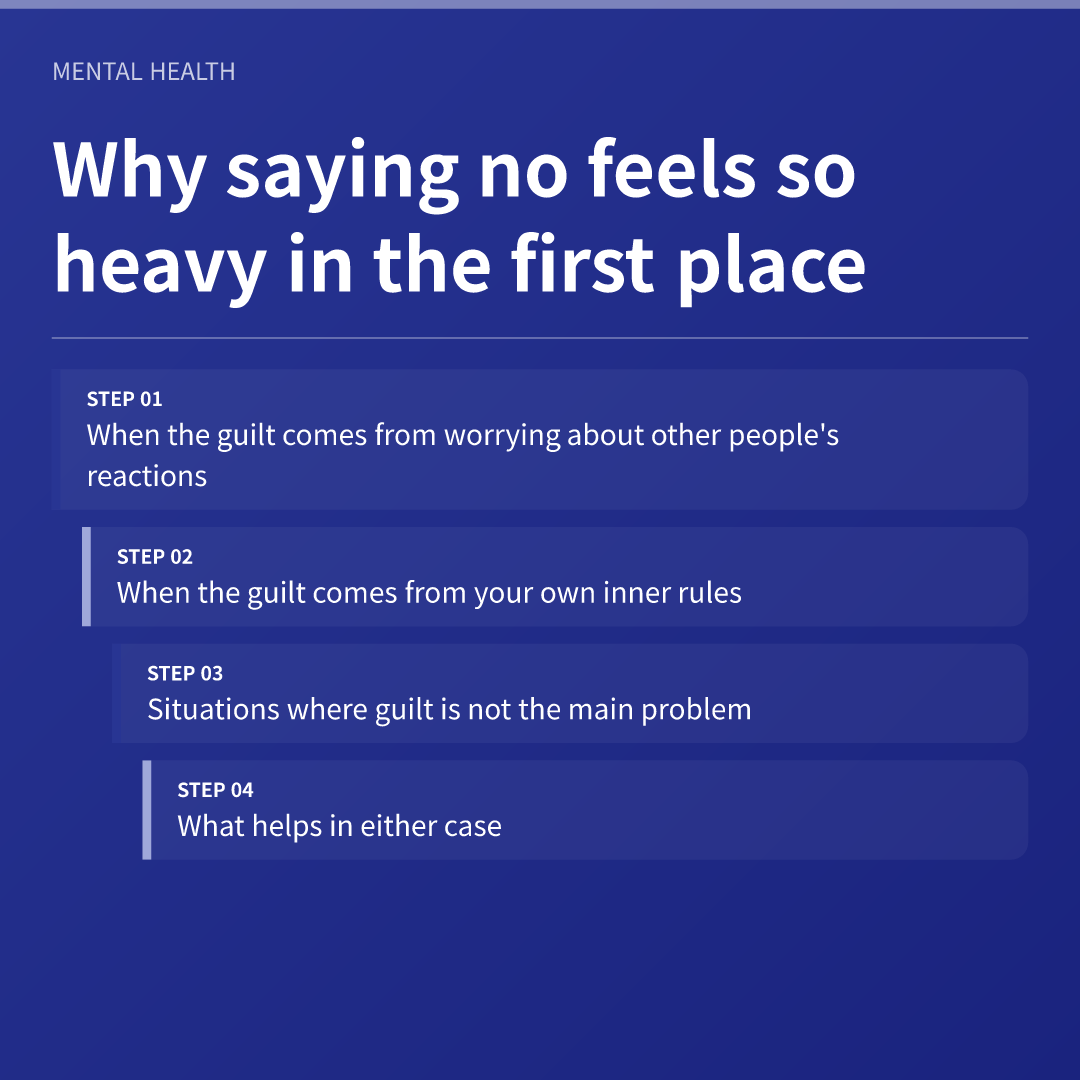
Why saying no feels so heavy in the first place
Guilt is a social emotion. It often signals that we care about other people and about being a good friend, colleague, partner, or family member. The trouble starts when the signal fires even though you have done nothing wrong, such as declining an extra project when your plate is already full.
Many people describe two broad patterns behind that misfiring alarm. In the first, the guilt is mostly about fear of how others will react: disappointment, anger, or being seen as unkind. In the second, it is about your own rules: an internal belief that your worth depends on being useful, available, or agreeable. The two can overlap, and some people notice both, but one usually leads.
Here is the catch. If you treat a reaction-fear problem with self-worth work, or the other way around, you may feel like you are trying hard and getting nowhere. A quick self-check helps you choose a better starting point.
A simple way to sort your pattern
Think about the last time you said yes when you wanted to say no. Then ask yourself what, specifically, you were picturing in that moment.
- If you pictured a particular person’s face, tone, or reply, the fear of their reaction may be leading.
- If you heard an inner voice saying things like “a good person would help” or “I should be able to handle this,” your internal rules may be leading.
- If both showed up, start with whichever felt louder and revisit the other later.
This is a rough self-reflection tool, not a diagnosis. If guilt around boundaries feels overwhelming, constant, or tied to past experiences that still hurt, a licensed mental health professional is the right person to talk with.
When the guilt comes from worrying about other people’s reactions
How to tell this is your situation
You may recognize this pattern if you rehearse conversations in your head, imagine worst-case responses, or agree to things mainly to keep the peace. You might feel fine about your decision until you have to deliver it. The discomfort peaks right before or right after you speak.
Another clue is that your reasoning is about the other person: “She’ll be upset,” “He’ll think I don’t care.” Those thoughts are understandable, especially if someone in your life has reacted badly to boundaries before.
What tends to help
When the main driver is fear of reactions, practical wording often matters more than deep self-reflection. A clear, kind, short response usually lands better than a long apology. Over-explaining can invite negotiation, because each reason you give becomes something the other person can try to solve.
Some phrasings people find workable include:
- “Thanks for thinking of me. I can’t take that on right now.”
- “I’m not able to commit to that, but I hope it goes well.”
- “That doesn’t work for me. Could we look at another option?”
Offering an alternative is optional, not a duty. It can soften things when you genuinely want to help in another way, but you are allowed to simply decline. Pairing warmth with a firm answer is often described as the sweet spot.
It can also help to separate the other person’s feelings from your responsibility. Someone can be disappointed without you having wronged them. Disappointment is a normal reaction to a no, not proof that you did something cruel.
What gets wasted if you misread the cause
If your guilt is really about your internal rules, polishing your script may not help much. You might have perfect wording and still feel awful afterward, then conclude that you are simply bad at boundaries. That conclusion is usually premature; it may just mean the script was not the missing piece.
When the guilt comes from your own inner rules
How to tell this is your situation
This pattern often shows up as guilt even when the other person responded kindly. Someone says “No problem at all!” and you still feel uneasy for hours. The discomfort lives in your head, not in the conversation.
You may also notice words like “should,” “selfish,” or “lazy” in your self-talk. Some people trace these beliefs to how they were raised, to roles they took on in their families, or to workplaces that rewarded constant availability. Others cannot point to a source, and that is fine too.
What tends to help
With this pattern, the work is less about what you say and more about how you talk to yourself afterward. Many people find it useful to name the rule out loud or on paper, such as “I believe I must always be available,” and then question whether it is really true and whether it serves them.
A few approaches people commonly describe:
- Reframing the no as a yes to something else. Declining a third evening event can be a yes to rest, your health, or time with someone you love.
- Treating guilt as information, not an order. A feeling can be present without being a reason to change your decision.
- Noticing what you would tell a friend. Most people are far kinder to a friend who sets a limit than to themselves.
Sitting with the discomfort, rather than fixing it by undoing your decision, is often described as the hard part. The feeling commonly eases with repetition, though how quickly varies widely from person to person.
What gets wasted if you misread the cause
If the real issue is fear of a specific person’s reaction, for example a manager who punishes refusals, then mindset work alone can leave you exposed. Telling yourself “I deserve boundaries” is valuable, but it does not change a difficult environment. In that case, practical strategies, documentation, or support from HR or a trusted advisor may matter more.
Situations where guilt is not the main problem
Sometimes the struggle to decline is tied to real pressure rather than a mindset quirk. Power imbalances, financial dependence, cultural expectations, and controlling relationships can all make saying no genuinely risky or costly. In those situations, feeling guilty is not a personal failing.
If saying no leads to threats, punishment, or fear for your safety, that is beyond a self-help article. Consider reaching out to a trusted person, a local support service, or a licensed professional who can help you think through options. Likewise, if chronic guilt comes with persistent low mood, anxiety, sleep trouble, or thoughts of harming yourself, please contact a qualified mental health professional or local emergency services promptly.
What helps in either case
Whichever pattern leads for you, a few habits tend to be useful across the board. None of them are magic, and results differ between people, but they give you a steady base to practice from.
Pause before answering
A default reply like “Let me check and get back to you” buys time. Many automatic yeses happen because the question arrives and the answer comes out before you have thought about it. A pause lets you check your real capacity.
Start with low-stakes practice
Declining a sales call, a optional committee seat, or an extra invite is lower risk than a big family conflict. Small repetitions build familiarity with the feeling of saying no and surviving it. Think of it like a muscle: it is awkward at first.
Know your limits ahead of time
It is easier to decline when you already know your priorities. If you have a sense of what energy, time, and money you can realistically give, each request becomes a comparison against something concrete instead of a fresh moral test.
Expect some awkwardness
Even well-delivered boundaries can feel uncomfortable, especially if people around you are used to your constant yes. Some may push back at first. That tends to be a reaction to change rather than a verdict on you, although how others respond is ultimately outside your control.
Talk to someone if it keeps hurting
If you have tried these ideas and guilt still feels intense, a therapist or counselor can help you explore where it comes from. Approaches differ, and a licensed professional can tell you what fits your situation better than a general article can.
Bringing it together
Learning how to say no without feeling guilty is less about finding one perfect sentence and more about matching your approach to the real source of the guilt. Here is a quick way to think about the two main branches in plain language.
If your guilt is mostly about how other people will react, the most helpful moves tend to be practical: short, warm, clear wording, less over-explaining, and separating their disappointment from your responsibility. If your guilt is mostly about your own inner rules, the focus shifts toward questioning those rules, treating guilt as a feeling rather than a command, and speaking to yourself the way you would to a friend. If the environment itself is unsafe or punishing, practical support and outside help matter more than mindset alone.
When it is hard to tell which branch fits, you have a few reasonable options. You can try one approach for a few weeks and notice whether anything shifts, you can keep a short private note of moments you said yes against your wishes and what you were thinking, or you can bring the question to a licensed counselor who can help you sort it out. None of these is wrong, and changing course is normal.
Saying no kindly is a skill, and guilt around it is common rather than a sign that something is broken. Be patient with the process, and remember that the goal is not to feel nothing, but to act in line with your values even when the feeling shows up.
Disclaimer: This article is for informational purposes only and is not a substitute for professional medical advice, diagnosis, or treatment. Please consult a licensed professional for personal health decisions.