How to Set Boundaries to Reduce Daily Stress
Learning how to set boundaries to reduce daily stress usually works better when it fits into three moments of your day, morning, midday, and evening, rather than becoming one big life overhaul. Small, repeated limits tend to stick because they ask for a few seconds of attention instead of a major personality change. Below is a walkthrough of what each part of the day can look like, why the timing matters, and where the limits of this kind of self-help sit.
A quick framing note first. A boundary is simply a line that describes what you will and will not do, what you are available for, and what you need in order to function well. It is not a punishment for other people, and it is not a wall. Many people find it helps to think of boundaries as information you share rather than rules you enforce.
Why Small Daily Boundaries Tend to Last
Stress often builds from lots of tiny leaks: a message answered at the dinner table, a favor accepted on autopilot, a morning that starts with other people's priorities. Big declarations like "I'm going to stop being a people-pleaser" can feel good for a day and then collapse. Little, specific limits are easier to repeat, and repetition is what makes them feel normal over time.
According to the National Institute of Mental Health's general guidance on stress, everyday stress responses vary widely between people, and healthy routines can be part of coping. That is a broad statement, not a promise about any single technique. What works for a parent of young children may look quite different from what works for someone managing a demanding remote job.
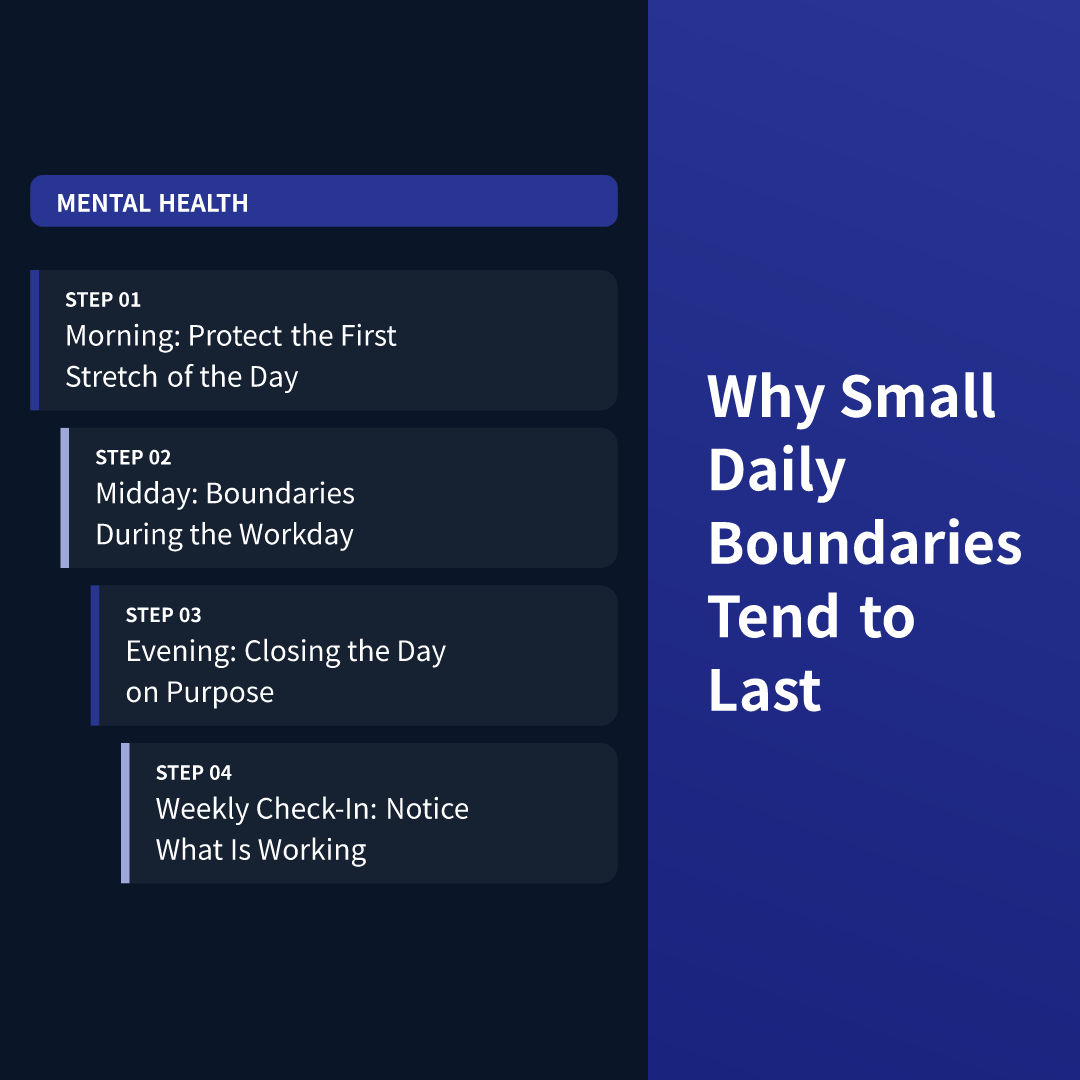
Morning: Protect the First Stretch of the Day
Mornings set the tone, not because they are magical, but because they are the one part of the day that is still mostly yours before other people's requests arrive. A boundary here is about deciding who and what gets access to you first.
Delay the inbox for a short window
One small action is to keep email, work chat, and news apps closed for the first stretch after waking, even if it is only until you have had breakfast or a drink. The reason for this timing is that reactive tasks tend to pull your attention into other people's agendas before you have had a chance to notice your own state. Some people find it easier to start by silencing notifications rather than avoiding the phone entirely.
Name your one priority
Another gentle habit is deciding on a single thing that matters most today, and giving yourself permission to let some lower-priority requests wait. Doing this in the morning matters because you are choosing before the day's demands blur your sense of what is important. It also gives you a ready-made reason when you need to say "I can't get to that today."
If mornings are chaotic because of caregiving or an early commute, scale this down. Even a single quiet minute before leaving the house, with no screen, counts as a boundary in practice.
Midday: Boundaries During the Workday
The middle of the day is where most boundary-testing happens: extra requests, meetings that run over, colleagues or family members who need something right now. This is the time when a short, pre-planned phrase can save a lot of mental energy.
Keep a few ready-made phrases
Having a couple of go-to sentences makes saying no less awkward in the moment. Examples that many people find workable include:
- "I can't take that on today, but I could look at it later in the week."
- "Let me check my schedule and get back to you."
- "I'm not available for that, but thank you for asking."
The timing matters because pressure to agree is strongest when someone is standing in front of you or waiting on a chat reply. A pause phrase like "let me get back to you" buys time to think, so you are not making a decision while your stress response is already running high.
Build in a real break
The second small action is protecting a short break away from your desk or main task. People often skip breaks when they are busiest, which is exactly when stress tends to climb. Treating a break as a scheduled commitment, rather than a reward you earn after finishing everything, makes it easier to defend when someone asks for "just five minutes."
The Centers for Disease Control and Prevention's general stress-coping guidance mentions taking breaks, including from news and social media, as one of several ways people manage stress. How long a break needs to be, and what feels restorative, differs from person to person.
When saying no is not simple
It is worth being honest that boundaries are easier in some situations than others. If you worry about job security, if a manager's expectations are rigid, or if you are in a relationship where pushback leads to conflict, a direct "no" may carry real costs. In those cases, smaller moves, such as asking about priorities ("Which of these should come first?"), can be a more practical starting point than refusing outright.
Evening: Closing the Day on Purpose
Evenings are where work and personal life tend to blur, especially for people who work from home or who are always reachable by phone. Boundaries here are less about saying no to others and more about marking an ending.
Create a clear stopping point
One helpful action is choosing a rough time when work talk and work tools are done for the day, then doing something small that signals the shift: closing the laptop, changing clothes, taking a short walk, or writing tomorrow's top task on a sticky note. The reason for doing this in the evening is that your mind needs a cue that unfinished items are parked, not forgotten. Writing the next step down can make it easier to stop turning it over in your head.
Set expectations about availability
The second evening habit is letting people know when you are and are not reachable. This might be a line in your email signature, a quiet-hours setting on your phone, or a simple conversation with family or colleagues. Sharing it ahead of time matters because people usually adjust more easily to a stated pattern than to a surprise refusal.
Sleep is closely tied to how stressed people feel the next day. The National Institutes of Health's general sleep guidance notes that routines and a calmer wind-down can support rest, though needs differ by person. If you notice that stress is regularly interfering with sleep, that is worth raising with a healthcare professional.
Weekly Check-In: Notice What Is Working
Boundaries are not set once and finished. Life changes, workloads shift, and a limit that felt fine last month may feel too loose or too rigid now. A brief weekly check-in, perhaps on a quiet weekend afternoon, helps you adjust without turning the whole thing into a project.
It also helps to expect some friction. People who are used to you being flexible may push back at first, and you may feel uncomfortable or guilty even when the boundary is reasonable. That discomfort is common and does not automatically mean you are doing something wrong. If the reactions you get are hostile, frightening, or controlling, that is a different situation, and talking with a counselor or another trusted professional can be useful.
A simple weekly checklist
- Which moments this week left me most drained, and what request or habit was behind them?
- Did I protect at least a few quiet minutes in the morning most days?
- Where did I say yes when I wanted to say no, and what made it hard?
- Did I take real breaks during the workday, or skip them?
- Did I have a clear stopping point in the evening on most days?
- Did anyone react strongly to a boundary, and was that reaction reasonable or concerning?
- Is there one small limit I want to adjust or try next week?
- Do I need support from a friend, family member, or professional to hold a boundary that feels too big on my own?
When to Seek Extra Support
Boundary-setting can be a useful everyday tool, but it is not a replacement for professional care. If stress feels constant, if you are struggling with persistent low mood, anxiety, trouble sleeping, or difficulty functioning, a licensed mental health professional or your primary care provider can help you work out what is going on. If you are in a relationship where you feel unsafe or controlled, reaching out to a trusted person or a local support service is important. In an emergency or if you are thinking about harming yourself, contact local emergency services or a crisis line in your area right away.
To sum up how to set boundaries to reduce daily stress: start small, tie each limit to a moment in your day, and review it weekly so it can change as your life does. Results differ from person to person, and some situations call for more support than self-guided habits can offer.
Disclaimer: This article is for informational purposes only and is not a substitute for professional medical advice, diagnosis, or treatment. Please consult a licensed professional for personal health decisions.
Related reading: Digital Boundaries for Better Mental Health