How to Warm Up Properly to Prevent Injury
Knowing how to warm up properly to prevent injury mostly comes down to easing your body into effort gradually: light movement first, then joint mobility, then gentler versions of what you are about to do. Many people skip this part because they are short on time, feel fine, or assume a few quick arm swings will do. Then a hamstring grabs, a shoulder feels pinchy, or a knee complains halfway through a run. Warming up cannot guarantee you will avoid every strain, and results vary from person to person, but fixing the order of what you do tends to matter more than adding extra minutes. The solution is about sequence.
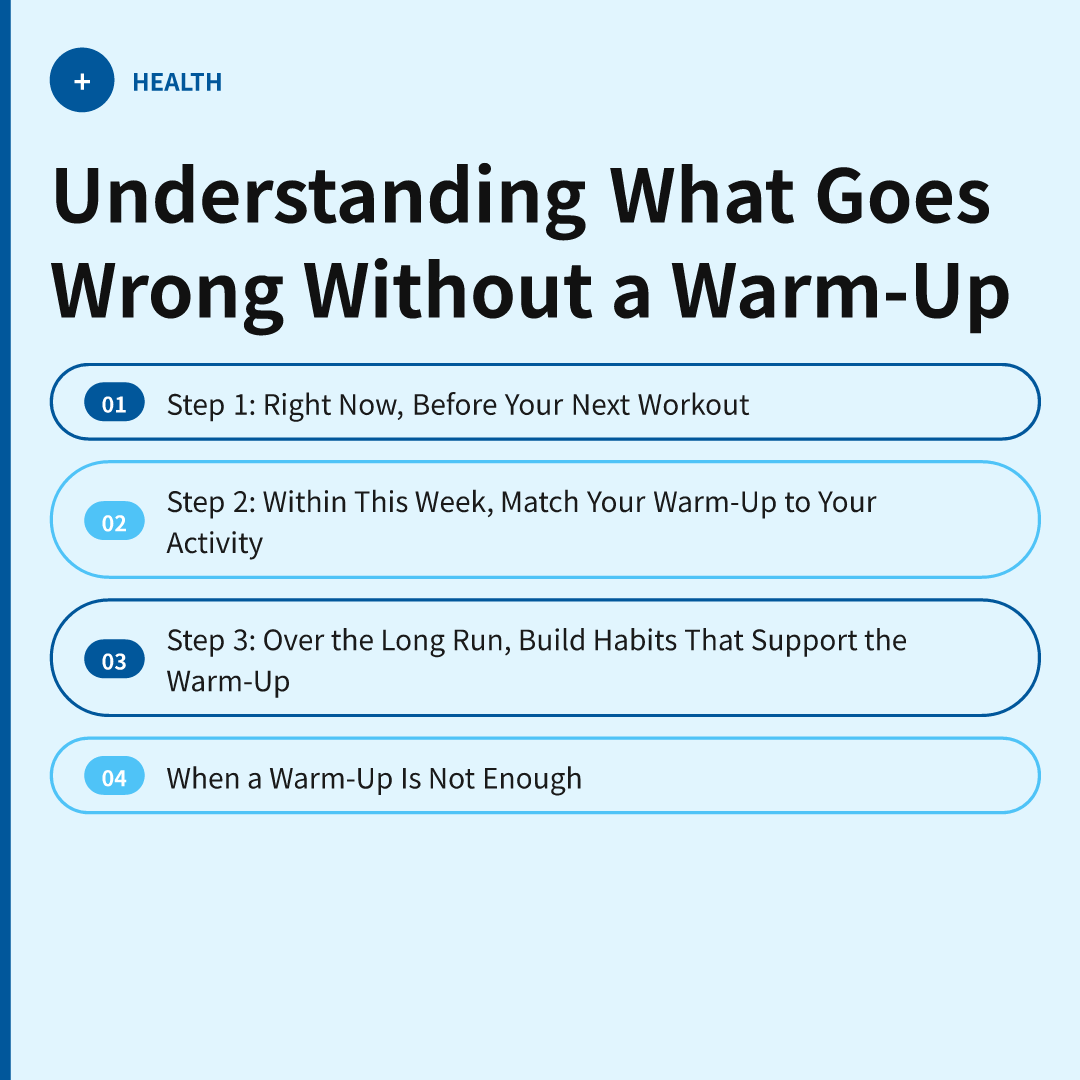
Understanding What Goes Wrong Without a Warm-Up
Before changing your routine, it helps to see where the trouble usually starts. Jumping straight into hard effort asks cold muscles, tendons, and joints to handle load they have not been prepared for. Stiffness, limited range of motion, and a heart rate that spikes too quickly can all make early minutes of exercise feel harder than they should.
According to general guidance from the Centers for Disease Control and Prevention (CDC), a warm-up is commonly described as light activity done before more vigorous exercise, and cooling down afterward is often recommended as well. The National Institutes of Health (NIH) and MedlinePlus also describe warming up as a way to prepare the body for activity. These sources explain the general idea; they do not promise that any routine eliminates injury risk.
Common mistakes worth recognizing
- Static stretching only: Holding a stretch while muscles are still cold is a habit many people carry over from school gym class. It may feel productive, but it does not raise your body temperature or rehearse the movements ahead.
- Doing the same thing for every workout: A quick jog is fine before an easy run, but it may not prepare shoulders for overhead lifting or hips for deep squats.
- Rushing the ramp-up: Going from zero to full effort in a minute or two leaves little time for the body to adjust.
- Ignoring old trouble spots: A tight calf, cranky lower back, or previously sore joint often needs a little extra attention rather than being pushed through.
Your own pattern may be different. Think about when discomfort usually shows up: in the first few minutes, in the middle, or the next morning. That clue helps you decide which of the steps below to focus on.
Step 1: Right Now, Before Your Next Workout
If you only change one thing today, change how the first several minutes of your session look. The aim is simple: raise your warmth and heart rate gently, then move your joints through the ranges you are about to use.
- What: Start with easy, general movement. How: Choose something low-intensity that uses large muscle groups, such as brisk walking, easy cycling, light jogging, or marching in place. Keep the effort conversational. Why: This gradually increases blood flow and body temperature, which is the basic purpose of a warm-up as described in general public health guidance.
- What: Add dynamic mobility. How: Move joints through controlled, comfortable ranges: arm circles, leg swings, hip circles, gentle torso rotations, and bodyweight movements like slow squats or lunges. Stay smooth and avoid bouncing or forcing range. Why: Dynamic movement rehearses the motions you are about to perform and tends to feel more connected to the workout than holding static poses.
- What: Do lighter versions of your main activity. How: If you are lifting, start with a light load and build up gradually. If you are running, begin with an easier pace before settling into your normal one. If you play a sport, begin with low-speed drills. Why: Practicing the pattern at lower effort lets your nervous system and tissues adapt before the real work begins.
How long this takes depends on your activity, the temperature around you, your age, and how your body feels that day. A cold morning or a long day at a desk may call for a bit more time than a warm afternoon after a walk. Pay attention to how you feel rather than chasing a fixed clock.
Signals that you are ready
Most people notice they feel looser, a little warmer, and mentally switched on. Movements that felt creaky at the start usually feel smoother. If something still feels sharp or restricted, it is reasonable to back off the intensity instead of pushing through.
Step 2: Within This Week, Match Your Warm-Up to Your Activity
Once you have a basic routine, the next job is tailoring it. A warm-up that fits one activity can be a poor match for another, so it is worth spending a few days noticing what your sessions actually demand.
- What: Identify the main joints and muscles your activity relies on. How: Write down two or three for each type of workout. Running leans on ankles, calves, hips, and hamstrings. Overhead pressing leans on shoulders, upper back, and wrists. Racquet sports ask a lot of shoulders, hips, and quick changes of direction. Why: Targeting these areas helps you spend limited time where it counts.
- What: Build a short sequence for each activity type. How: Pair general movement with three or four mobility exercises aimed at your list, followed by a lighter version of the main movement. Keep the sequence in the same order each time so it becomes automatic. Why: A repeatable pattern is easier to stick with than an elaborate plan you have to think about.
- What: Adjust for conditions and how you feel. How: Allow extra ramp-up time on cold days, after long periods of sitting, or when you are returning from a break. Go gentler if you are tired or sore. Why: Your body is not the same every day, and a flexible warm-up respects that.
If you have a history of injury
People with a past injury, joint condition, or ongoing pain may need a different approach than the general suggestions here. A physical therapist, athletic trainer, or other qualified professional can look at your situation and suggest movements that fit it. Any exercise that reliably brings on sharp or worsening pain is a signal to stop and get advice rather than a cue to warm up harder.
Step 3: Over the Long Run, Build Habits That Support the Warm-Up
A good warm-up works best as part of a wider pattern. It cannot make up for everything else, and it will not protect you if training load jumps too quickly or recovery is neglected.
- What: Increase training gradually. How: Raise distance, speed, or weight in small steps rather than making big leaps from one week to the next. Why: Many overuse problems are associated with doing too much, too soon, and a warm-up cannot fully offset that.
- What: Include a cool-down and regular mobility work. How: Ease the intensity down at the end of a session, and consider separate stretching or mobility time on other days when your muscles are warm. Why: General public health guidance often pairs warming up with cooling down, and flexibility work done outside the pre-workout window may fit more comfortably into your week.
- What: Support recovery. How: Allow rest days, pay attention to sleep, and eat and drink in ways that support activity. Why: Tired, under-recovered tissue tends to handle load less well, and individual needs vary widely.
- What: Build strength and balance over time. How: Many people include regular strengthening and balance work in their routines. Why: The CDC and other public health agencies generally describe muscle-strengthening activity as part of overall physical activity guidance, and stronger supporting muscles may help joints cope with demand.
Keep it realistic
The best routine is one you will actually do. If a ten-step warm-up feels like homework, you will skip it on busy days. A shorter version you perform consistently usually beats a perfect plan that lives only in your notes app.
When a Warm-Up Is Not Enough
Even a thoughtful routine on how to warm up properly to prevent injury has limits. Pain, stiffness, or strains can still show up, and some symptoms deserve attention from a qualified professional rather than more DIY tweaking.
Consider contacting a doctor, physical therapist, or other licensed healthcare professional if you notice any of the following:
- Pain that is sharp, getting worse, or lasts well beyond the usual soreness that follows exercise
- Swelling, bruising, or a joint that feels unstable, locks, or gives way
- Numbness, tingling, or weakness in an arm or leg
- Pain that wakes you at night or shows up at rest
- Repeated problems in the same spot despite adjusting your routine
- Any chest pain, unusual shortness of breath, dizziness, or fainting during activity, which calls for prompt medical attention
People with heart or lung conditions, those who are pregnant, older adults starting a new program, and anyone managing a chronic health issue may benefit from talking with a healthcare professional before changing their exercise habits. A clinician or qualified trainer can also review your technique, training load, and movement patterns, which are things a general article cannot assess.
To sum up the practical path: begin with easy movement, add joint mobility, ramp into your main activity gradually, tailor the routine to what you do, and build supporting habits over time. If problems persist, bring them to someone who can examine you in person.
Disclaimer: This article is for informational purposes only and is not a substitute for professional medical advice, diagnosis, or treatment. Please consult a licensed professional for personal health decisions.