Cold Showers After Workouts: Do They Help Recovery?
Cold showers after workouts may make sore muscles feel better for a short while, but the evidence that they speed up real recovery is mixed. The most useful window to think about runs from the first hour after exercise to roughly a few days later, and your body is doing different things at each stage. This article walks through that timeline, what a cold shower might and might not do along the way, and why people respond so differently.
If you only want the short version: many people find cold water refreshing and a bit soothing after hard sessions, and some research suggests cold exposure may reduce the feeling of soreness. Other research raises questions about whether regular cold exposure could blunt some of the adaptations that strength training is meant to build. Neither side offers a guarantee, and results vary from person to person.
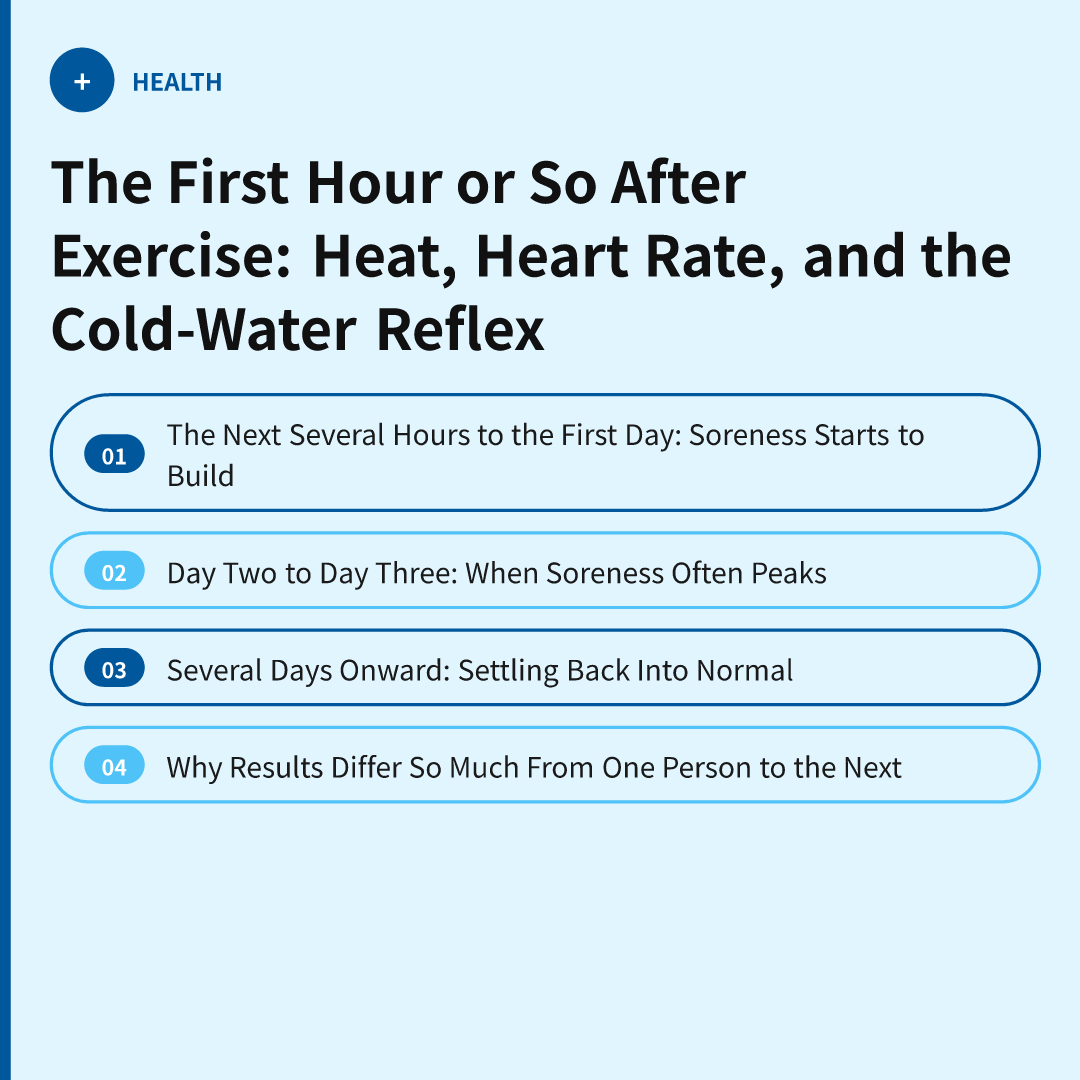
The First Hour or So After Exercise: Heat, Heart Rate, and the Cold-Water Reflex
What is happening in your body
Right after a hard workout, your core temperature and heart rate are usually elevated, and your muscles have been working under stress. Tiny amounts of muscle fiber disruption are a normal part of training, and the body begins its repair and inflammation response almost immediately. This is the process that often leads to the stiff, achy feeling that arrives later.
Stepping into cold water adds another layer. Cold exposure typically triggers a gasp reflex, faster breathing, and constriction of blood vessels near the skin. Many people describe feeling alert and clear-headed afterward, which is a real sensation even if it does not prove anything about muscle repair.
What people commonly do
- Cool down gradually first, with easy movement and normal breathing, before any cold exposure.
- Rehydrate and eat something, since fluids and food are widely discussed as basic recovery building blocks.
- Use a cold shower for comfort or mental reset, rather than treating it as a required recovery step.
What to be cautious about
Sudden cold water on a body that is still overheated can be a shock to the system. The American Heart Association and other health agencies generally note that abrupt temperature changes can strain the heart, which matters more for people with heart or blood pressure conditions. Anyone with a cardiovascular condition, a history of fainting, or Raynaud's phenomenon would be wise to ask a clinician before trying cold exposure.
It is also worth avoiding very long or very cold exposure, especially if you feel dizzy, numb, or unusually shaky. Comfort is a reasonable guide, and "tougher" is not automatically better.
The Next Several Hours to the First Day: Soreness Starts to Build
What is happening in your body
Over the following hours, inflammation and fluid shifts in worked muscles often increase. Delayed onset muscle soreness, usually called DOMS, tends to creep in rather than appear instantly, and it is a common experience after unfamiliar or intense exercise. The NIH and MedlinePlus general guidance describes muscle soreness after exertion as common and usually temporary.
Cold water immersion, which is different from a brief cold shower, is something some people try when they feel sore, and how much it helps varies from person to person. That is not the same as saying the muscle heals faster. How much a short shower compares with a full cold bath is also unclear, since the exposure is usually shorter and covers the body differently.
What people commonly do
- Light walking or gentle movement, which many people find eases stiffness.
- A cold or cool shower if it feels good, treated as a comfort measure.
- Regular meals and fluids, plus an ordinary night of sleep, which are usually considered the foundation of recovery.
What to be cautious about
Soreness relief and muscle recovery are not identical. If a cold shower dulls the ache, you may feel ready to push hard again before the tissue is actually ready, which can raise the chance of overdoing it. Pain that feels sharp, localized, or different from usual soreness deserves attention rather than masking.
Related reading: How to Reduce Muscle Soreness After a Hard Workout
Day Two to Day Three: When Soreness Often Peaks
What is happening in your body
For many people, soreness feels strongest somewhere in the second or third day after a tough session, then gradually fades. During this time the body is continuing to repair muscle fibers and adapt to the stress it experienced. This adaptation is the point of training, which is why researchers keep asking whether routinely cooling the body right after exercise could interfere with it.
If you lift weights regularly, it is worth asking a coach or clinician how often cooling off after sessions fits your goals, since experiences differ between people. The findings are not uniform, they often involve full-body cold baths rather than showers, and they do not apply equally to everyone. For someone training mainly for general fitness, the practical impact is uncertain.
What people commonly do
- Choose lighter activity such as walking, easy cycling, or mobility work.
- Keep protein, carbohydrates, and fluids consistent with their usual eating pattern.
- Consider spacing cold exposure away from strength sessions if building muscle is a priority, a topic worth raising with a coach or sports medicine professional.
What to be cautious about
Relying on cold showers as the only recovery strategy is a common trap. Sleep, nutrition, and sensible training load are generally viewed as having a larger role. Pushing through worsening pain, swelling, or reduced movement is also a reason to pause and get checked.
Several Days Onward: Settling Back Into Normal
What is happening in your body
By the end of the first week, ordinary post-workout soreness usually settles for most healthy people, and muscles often feel normal again. The body has by then adjusted somewhat to the load, which is part of why the same workout often feels easier the next time. This is the stage where long-term habits matter more than any single cold shower.
What people commonly do
- Return to regular training gradually, listening to how the body responds.
- Continue using cold showers if they enjoy them, mainly for alertness or comfort.
- Pay attention to patterns, such as whether soreness is getting worse across weeks instead of better.
What to be cautious about
Ongoing heavy fatigue, declining performance, or soreness that never seems to clear can point to something other than a normal recovery curve, such as too little rest or an underlying issue. A cold shower is not designed to fix that, and it should not delay a conversation with a professional.
Why Results Differ So Much From One Person to the Next
Almost every part of this topic depends on the individual. Fitness level, the type of exercise, how often you train, age, sleep, nutrition, stress, and general health all play a role. A person doing endurance work may respond differently from someone lifting for muscle size, and a first-time runner may have a very different experience from a seasoned athlete.
The cold itself varies too. A brief cool rinse, a long very cold shower, and a full ice bath are not interchangeable, and most research tends to focus on immersion. Personal tolerance matters as well, since some people feel energized by cold water and others feel miserable or lightheaded.
Who may want to check with a professional first
- People with heart disease, high blood pressure, or circulation problems.
- Anyone with Raynaud's phenomenon or cold sensitivity.
- People who are pregnant, older adults, or those taking medicines that affect circulation or blood pressure.
- Anyone recovering from an injury or with numbness or nerve problems.
If recovery feels slower than expected, a sensible order to check things
- Look at the basics first. Consider whether sleep, hydration, and food intake have slipped lately, since these are commonly linked with slower recovery.
- Review your training load. A sudden jump in intensity, volume, or frequency is a common reason soreness lingers.
- Reconsider the cold exposure. If you are using cold water often after strength sessions, you might discuss timing with a coach or sports professional, particularly if progress has stalled.
- Notice the type of pain. Sharp, one-sided, or worsening pain, visible swelling, bruising, or loss of movement is different from general soreness and is worth a medical visit.
- Watch for warning signs. Very dark urine, severe muscle weakness, intense swelling, chest pain, fainting, or trouble breathing call for prompt medical care, and the CDC and other health agencies advise seeking urgent help for symptoms like these.
- Talk to a qualified professional. A physician, physical therapist, or sports medicine clinician can look at your whole picture, which a general article cannot do.
So, do cold showers after workouts help recovery? They may help some people feel less sore and more refreshed in the short term, while the evidence for faster actual muscle repair is limited and the effect on training adaptations is still debated. If you enjoy them and have no health concerns, they are generally treated as a personal-preference habit. If something feels off, or recovery drags on, a professional is a better guide than any shower.
Disclaimer: This article is for informational purposes only and is not a substitute for professional medical advice, diagnosis, or treatment. Please consult a licensed professional for personal health decisions.