How to Reduce Muscle Soreness After a Hard Workout
The most dependable way to reduce muscle soreness after a hard workout is to support the body’s own repair process: gentle movement, regular food and fluids, and enough sleep, while giving the sore tissue time. Soreness usually peaks a day or two after unfamiliar effort and then fades on its own. Zoom in on a muscle the morning after a punishing session and you can see why. Thousands of thread-like fibers have been stretched and loaded harder than usual, and the body is already sending in a repair crew.
Below is a tour of what happens inside the muscle, which factors are involved, what tips the balance toward more pain, and how recovery unfolds. Individual experiences vary a great deal, so treat this as general information rather than a personal plan.
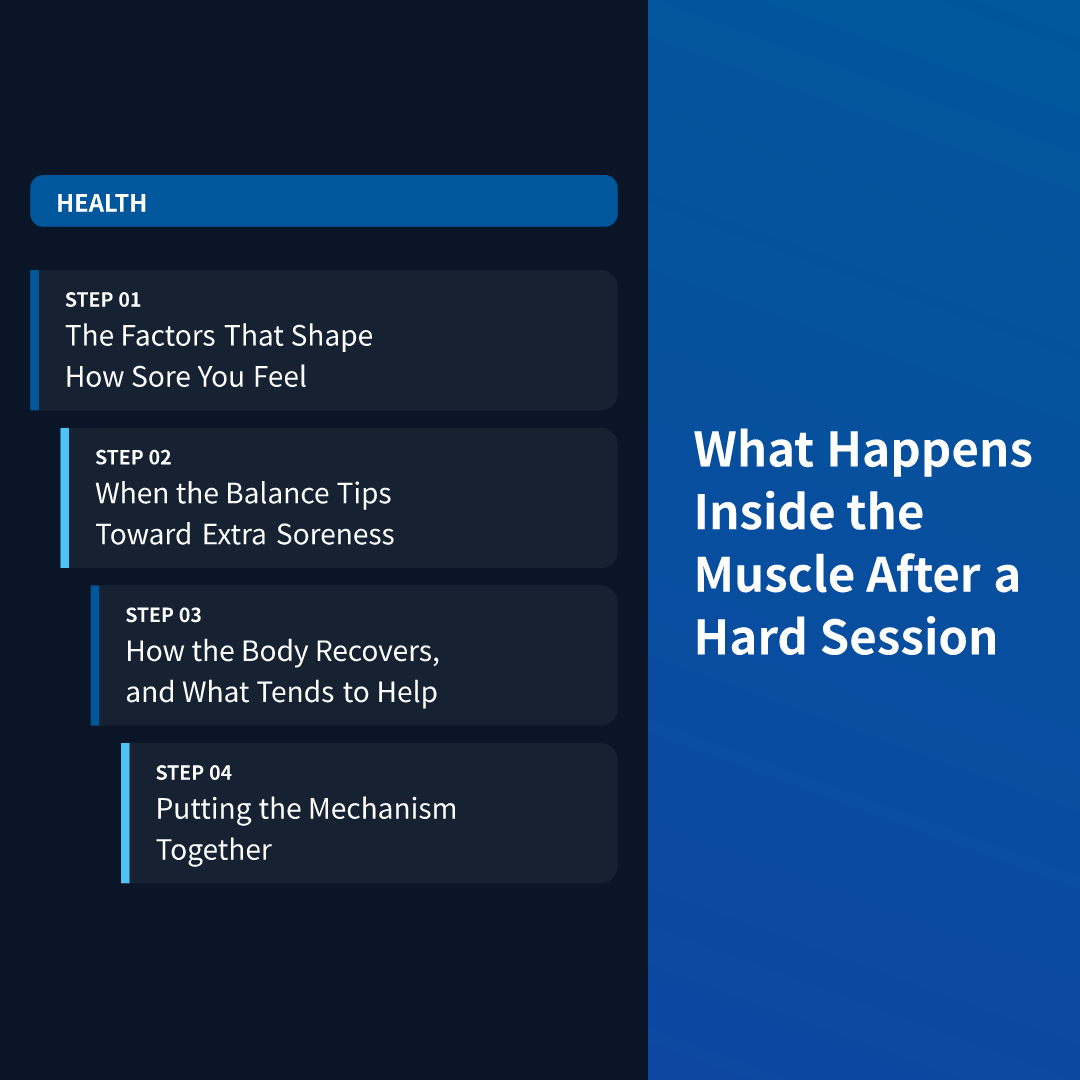
What Happens Inside the Muscle After a Hard Session
The medical name for that stiff, achy feeling is delayed onset muscle soreness, often shortened to DOMS. In everyday terms, it is the soreness that shows up several hours later and tends to be worst a day or two after the workout, not while you are exercising.
Under a microscope, the story begins with microscopic damage to muscle fibers and their surrounding connective tissue. Think of it as tiny frays in a rope rather than a snapped cable. This is most common with eccentric contractions, where a muscle lengthens while it is under load, such as lowering a weight, running downhill, or descending stairs.
Once those small disruptions occur, the area becomes irritated. Fluid and immune cells arrive, and nerve endings in and around the muscle become more sensitive. That is why a stretch or a press on the area can hurt more than usual, and why everyday movements like standing from a chair feel surprisingly hard.
Why the soreness is delayed
The lag exists because the inflammatory and repair response takes time to build. Inflammation, the body’s normal cleanup and rebuilding signal, ramps up over many hours instead of minutes. By the time you notice the ache, the repair process is already well underway.
The Factors That Shape How Sore You Feel
Several overlapping elements influence the intensity. No single one explains everything, which is part of why two people can do the same workout and feel very different the next day.
- Novelty of the movement: A new exercise, or a familiar one done differently, tends to cause more soreness than a routine the body has adapted to.
- Type of muscle action: Lengthening-under-load movements are widely associated with more soreness than lifting or pushing phases alone.
- Volume and intensity: A big jump in workload, such as extra sets, heavier loads, or longer distance, gives the tissue more to repair.
- Individual variation: Training history, genetics, age, sleep, and stress all appear to play a role, and researchers do not fully understand every piece.
The repeated bout effect is worth knowing about. After a muscle has been challenged once, it generally becomes more resistant to soreness from the same type of effort, which is why the second week of a new program often feels easier than the first.
Fuel, fluids, and rest as raw materials
Repair is a building project, and building needs materials and time. According to the U.S. Department of Agriculture’s general dietary guidance, a varied eating pattern that includes protein-containing foods, produce, and whole grains supports overall health, which includes the body’s ability to recover from activity. Staying hydrated and eating regularly are commonly recommended habits, though needs differ by person.
Sleep matters too. The Centers for Disease Control and Prevention notes that sleep supports many body functions, and many people notice they feel more sore and sluggish when they have been short on rest. sleep and exercise recovery
When the Balance Tips Toward Extra Soreness
Normal soreness is a sign of manageable stress followed by adaptation. Problems arise when the load outruns the body’s ability to repair, or when something else is going on that mimics ordinary soreness.
Common situations that tend to make soreness worse include a sudden spike in training after time off, stacking several demanding sessions without recovery days, and trying an unfamiliar, heavily eccentric activity at full effort. Poor sleep, low food intake, and high life stress can also leave the body with fewer resources for repair.
Soreness versus injury
It helps to tell the two apart. General soreness is usually spread across the worked muscles, feels dull or tight, affects both sides similarly, and gradually improves over several days. Injury pain is more often sharp, sudden, focused in one spot, or tied to a specific moment during the workout.
According to the National Institutes of Health’s general musculoskeletal information, pain that is severe, accompanied by significant swelling, or that limits normal use of a limb deserves attention instead of waiting it out. The following are reasons to contact a qualified health professional promptly:
- Very dark or tea-colored urine after intense exercise, especially with severe muscle pain or weakness, which can be a sign of a serious muscle breakdown condition called rhabdomyolysis.
- Marked swelling, a limb that feels unusually tight, or pain that keeps worsening instead of easing.
- Numbness, tingling, or loss of strength.
- Pain after a clear injury such as a pop, a fall, or a twist.
- Soreness that lingers well beyond the usual several days without improving.
- Chest pain, shortness of breath, or dizziness, which need urgent medical care.
How the Body Recovers, and What Tends to Help
Recovery is not a single event. Over days, the inflammatory cleanup winds down, damaged proteins are cleared and rebuilt, and the muscle often comes back more resilient to that kind of stress. Most ordinary soreness resolves without any special treatment, typically within several days.
Many people explore comfort measures along the way. Evidence for each is mixed, and the effects tend to be modest and vary by individual, so it is better to think of them as options people commonly use rather than fixes.
Gentle movement
Light activity such as walking, easy cycling, or relaxed mobility work is widely used because it keeps blood moving and can make stiff muscles feel looser. Some people find that it eases the achiness temporarily. Intensity should stay low enough that it does not add to the damage.
Massage and foam rolling
Some studies have suggested that massage or foam rolling may temporarily lessen the perception of soreness for some people. Results are inconsistent, and pressure that feels sharp or painful is a sign to back off. Anyone with a bleeding disorder, blood clot history, or who takes blood thinners should check with a clinician first.
Heat, cold, and water
Warm baths, heating pads, cool showers, and cold water immersion are all popular. People tend to report that warmth feels soothing for tightness and that cold feels numbing for acute achiness, but research has not settled which, if any, speeds true recovery. Skin sensitivity, circulation problems, and certain medical conditions make extreme temperatures riskier, so comfort and caution should lead.
Food, drinks, and supplements
Regular meals and fluids are the foundation. Supplements marketed for recovery are a different matter. The FDA does not approve dietary supplements for effectiveness before they are sold, and the Federal Trade Commission has warned that recovery and performance claims can be exaggerated. Anyone considering a supplement, especially people who are pregnant, take medications, or have a health condition, should talk with a pharmacist or doctor first.
Pain relievers
Over-the-counter pain relievers come with their own cautions, including stomach, kidney, and liver considerations depending on the product and the person. Whether one is appropriate, and how it should be used, is something to settle with a pharmacist or doctor and the product label, not guess at. The same goes for creams, patches, and rubs: read the label and ask a pharmacist before using them.
Building up gradually
The most useful long-term approach is not a recovery trick at all. Raising workload step by step lets the repeated bout effect do its job, so later sessions of the same type tend to leave you less sore. A warm-up and a cool-down are widely suggested as sensible habits, although they are not guaranteed to prevent soreness.
Putting the Mechanism Together
Muscle soreness is a signal that the tissue was challenged, not a measure of how good the workout was. Many people feel little soreness and still make steady progress, and others feel plenty without gaining anything extra from it.
- Unfamiliar, lengthening-under-load effort creates small fiber disruptions, and the body’s inflammatory repair response makes the area tender a day or two later.
- Novelty, workload, sleep, nutrition, and personal differences all shift how strong the soreness feels.
- Gentle movement, regular meals and fluids, rest, and gradual progression support the body’s own repair, while most other tools offer modest or uncertain benefit.
One important exception to this picture: the soreness explanation does not hold when pain is sharp, one-sided, accompanied by major swelling, weakness, or dark urine, or when it does not improve over several days. Those patterns can point to an injury or a medical condition, and they call for evaluation by a qualified professional. When it comes to figuring out how to reduce muscle soreness after a hard workout, knowing which kind of pain you have comes first.
Disclaimer: This article is for informational purposes only and is not a substitute for professional medical advice, diagnosis, or treatment. Please consult a licensed professional for personal health decisions.