Journaling Prompts for Stress Relief: Where to Begin
Interest in journaling prompts for stress relief tends to rise whenever daily life feels harder to manage than usual — a demanding work stretch, a personal transition, or simply a season where sleep and focus start slipping. People often land on this topic after trying to “just relax” and finding that advice too vague to act on. A structured prompt gives the mind something concrete to do instead of spinning in place.
At its core, a journaling prompt is a short question or writing cue designed to guide someone through their thoughts rather than leaving them to stare at a blank page. For stress specifically, these prompts usually aim to help a person name what they’re feeling, separate facts from worry, and notice patterns that keep resurfacing. It’s less about literary writing and more about giving scattered thoughts a place to land.
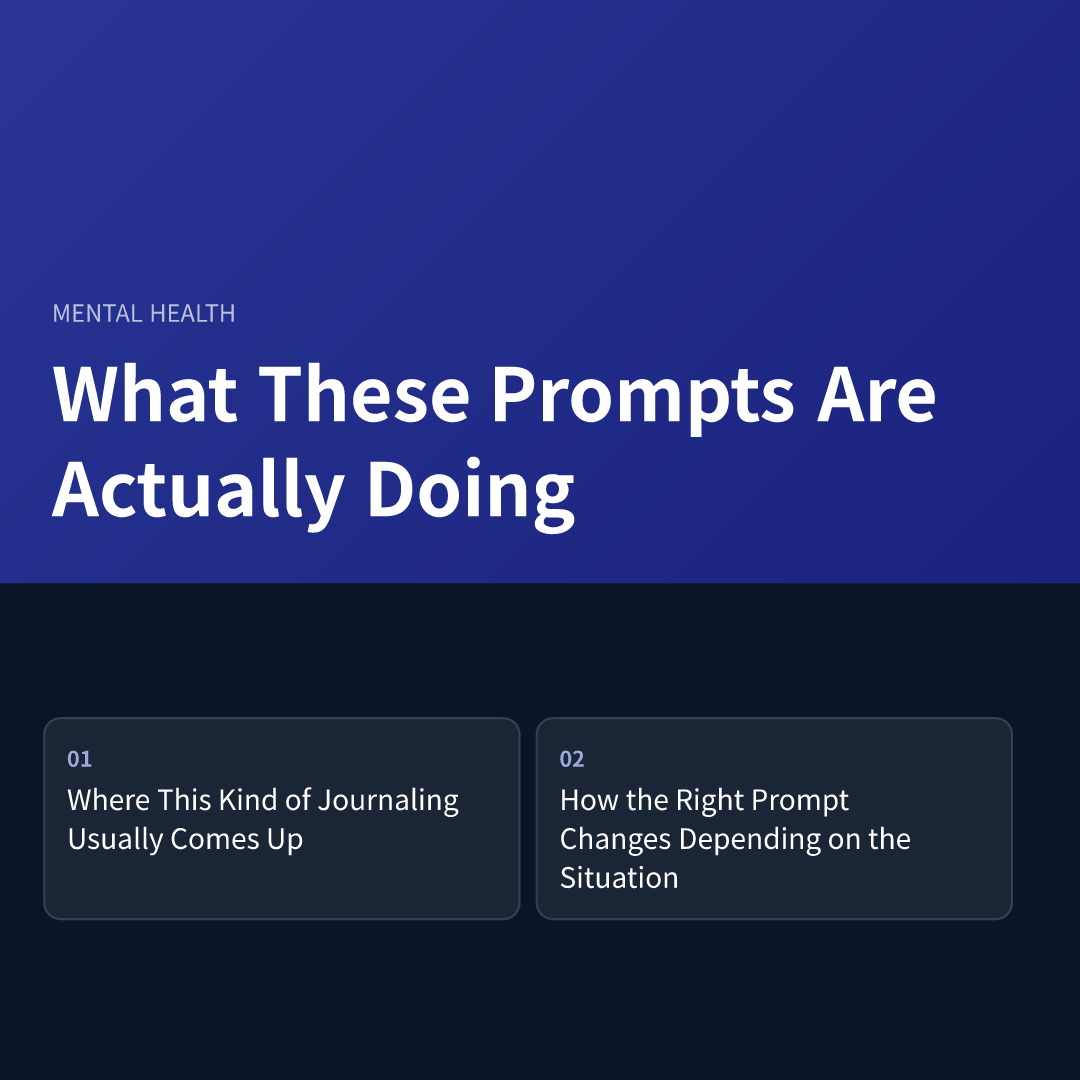
Where This Kind of Journaling Usually Comes Up
Journaling for stress tends to appear in two common situations. The first is during an acute stretch — a looming deadline, a family conflict, or a health scare — where someone needs a quick way to offload mental noise before it affects sleep or decision-making. The second is more preventive: people build a regular writing habit as part of a broader stress management routine, alongside things like exercise or better sleep hygiene.
Consider a general example: someone preparing for a big presentation at work might notice their thoughts looping the night before — replaying worst-case scenarios instead of resting. In this kind of moment, a prompt like “What is the actual worst outcome, and how likely is it?” can pull the mind out of a vague spiral and into something more specific and manageable.
A second general scenario involves someone going through a slower-burning stress, like ongoing tension with a family member. Here, the goal isn’t a quick fix but a way to track recurring feelings over time. Prompts used this way tend to focus on identifying triggers rather than resolving the issue in a single sitting.
What These Prompts Are Actually Doing
It helps to understand what a stress-focused prompt is trying to accomplish, since that shapes which kind of question is useful in a given moment. Broadly, these prompts fall into a few overlapping functions:
- Naming the feeling — putting a word to an otherwise vague sense of unease, which some approaches to emotional processing suggest can make a feeling easier to sit with.
- Separating fact from interpretation — distinguishing “what happened” from “what I’m afraid it means.”
- Tracking patterns — noticing that the same trigger, time of day, or thought keeps showing up.
- Creating distance — writing something down so it isn’t just looping silently in the mind.
None of this is a guaranteed fix, and that’s worth saying plainly. Journaling is generally described as a supportive habit for self-reflection and mindfulness journaling, not a replacement for treatment when stress becomes persistent or overwhelming. For general background on how expressive writing is discussed in mental health contexts, resources like the National Institute of Mental Health’s page on coping with stress offer a broader, non-promotional overview.
simple daily habits that support mental wellness
How the Right Prompt Changes Depending on the Situation
Not every prompt fits every kind of stress. A question that helps with racing nighttime thoughts might feel irrelevant to someone dealing with slow, grinding burnout. It can help to think of prompts in categories, matched loosely to what a person is experiencing.
| Situation | Example Prompt | General Purpose |
|---|---|---|
| Racing thoughts before sleep | “What’s one thing I can let go of until tomorrow?” | Reduces mental looping, supports wind-down routine |
| Overwhelm from too many tasks | “What actually needs my attention today, and what can wait?” | Helps prioritize, lowers sense of chaos |
| Ongoing tension or conflict | “What pattern have I noticed in how this situation makes me feel?” | Builds awareness over time rather than instant relief |
| General low mood or flatness | “What’s one small thing that felt okay today?” | Gently shifts focus without forcing positivity |
The table above is a general starting reference, not a fixed formula. Someone might find that a “letting go” prompt does nothing for them but a prioritization prompt works well, or the reverse. Personal variation here is normal, and it often takes some trial and error to notice which style of question actually settles the mind rather than stirring it up further.
When Journaling Style Might Need Adjusting
Some people find open-ended prompts (“How do I feel right now?”) too broad when they’re already overwhelmed, and prefer more structured ones instead. Others find rigid prompts stifling and do better with free writing that starts from a single cue word. There isn’t a universally “correct” format — the point is whether the practice makes stress feel more manageable, even slightly, after a few attempts.
Common Misunderstandings About Stress-Focused Journaling
One frequent misunderstanding is treating journaling as something that should produce an immediate emotional shift, almost like a light switch. In practice, many people describe it as a slower, cumulative habit — a pattern noticed over weeks rather than a single “aha” moment after one entry. Expecting instant calm can lead someone to abandon the habit too early.
Another common mix-up is assuming that more detail is always better. Long, exhaustive entries can sometimes reinforce rumination rather than relieve it, especially if the writing keeps circling the same worry without a shift in perspective. A short, prompt-guided entry can be more useful precisely because it has a boundary.
There’s also a tendency to think journaling alone should replace other forms of support. For everyday stress, writing can be a genuinely useful coping strategy. But when stress starts to affect sleep, appetite, relationships, or the ability to function at work or school over an extended period, that generally points toward something a personal journal isn’t equipped to handle on its own — this is where talking to a doctor, therapist, or counselor becomes the more appropriate step.
Journaling is best understood as a tool for noticing and organizing thoughts, not as a stand-in for professional mental health care when symptoms are severe or ongoing.
Bringing the Practice Together
Used thoughtfully, journaling prompts for stress relief can offer a low-barrier way to slow down racing thoughts, sort through what’s actually happening versus what’s feared, and notice patterns that repeat over time. The specific prompt that works well tends to depend on the type of stress — acute versus ongoing — and on individual preference for structure versus open-ended writing.
A Short Wrap-Up
To summarize the main points: journaling prompts work best as a supportive habit rather than a guaranteed solution, the right prompt style varies by person and situation, and consistent small entries tend to be more sustainable than long, infrequent ones. If stress feels persistent, intense, or is interfering with daily functioning despite trying self-help approaches like journaling, that’s a reasonable signal to reach out to a qualified mental health professional or primary care provider rather than relying on writing alone. Journaling prompts for stress relief can be a genuinely helpful starting point, but they work best as one part of a broader approach to caring for mental health.
Disclaimer: This article is for informational purposes only and is not a substitute for professional medical advice, diagnosis, or treatment. Please consult a licensed professional for personal health decisions.