Loneliness and Health: Practical Ways to Connect
Loneliness and health have become a common pairing in search results, and it is easy to see why. Many people work from home, move to new cities, or find that old friendships have thinned out without anyone deciding they should. Public health agencies have started treating social connection as part of overall wellbeing, which has pushed the topic into everyday conversation.
Loneliness is the uncomfortable feeling that your social connections are fewer or shallower than you want them to be. It is not the same as being alone, and it is not a personal failing. This article explains how loneliness tends to show up, how it relates to wellbeing, which small steps people commonly use to reconnect, and when it makes sense to talk with a professional.
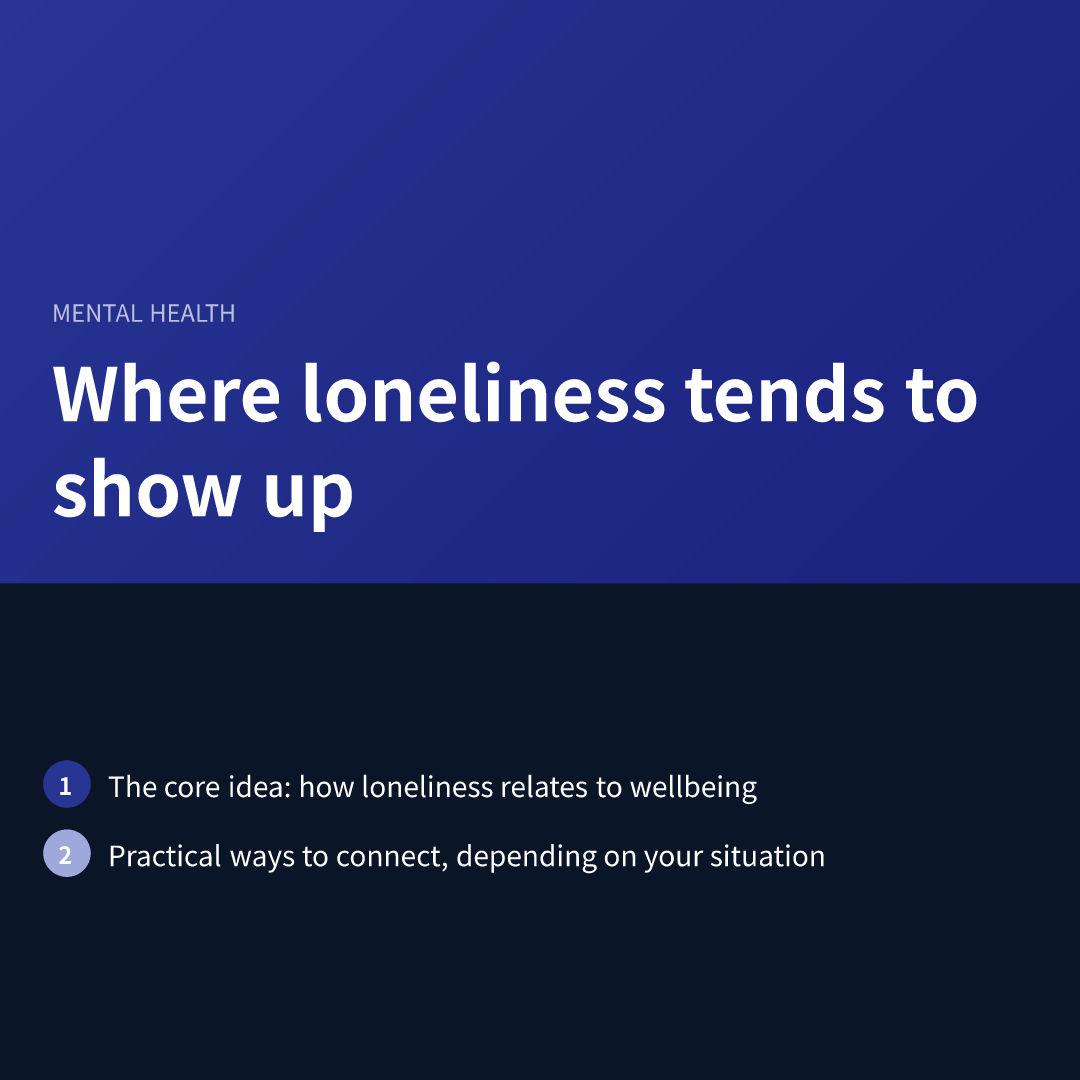
Where loneliness tends to show up
Loneliness rarely arrives with a label. It often appears during transitions: starting a new job, moving, retiring, becoming a parent, ending a relationship, or losing someone close. It can also show up in the middle of a full calendar, when you are surrounded by people but do not feel known by any of them.
A scenario: the new city
Picture a hypothetical person, Dana, who relocates for work. Her days are busy, and colleagues are friendly, but evenings are quiet. She scrolls her phone, sees friends back home making plans, and starts to feel a little invisible. Nothing is dramatically wrong, yet she notices she is sleeping poorly and feeling flat on weekends.
A scenario: the quiet after a life change
Now picture another hypothetical person, Sam, who recently retired. For decades, work supplied daily contact without any effort. Now the phone rarely rings, and reaching out feels awkward, as if he is imposing. Sam does not describe himself as lonely, but he admits the days feel long.
These are general illustrations, not real cases. They show that loneliness is usually tied to circumstances rather than character, which is one reason it can be addressed with practical changes.
The core idea: how loneliness relates to wellbeing
According to the U.S. Surgeon General's public advisory on social connection, loneliness and isolation have been linked with a range of physical and mental health concerns, and strong relationships are generally associated with better wellbeing. The CDC likewise describes social connectedness as an important part of health. Researchers are still sorting out cause and effect, since poor health can also make it harder to stay socially connected.
It helps to separate a few related terms:
- Loneliness: a subjective feeling that your connections fall short of what you need.
- Social isolation: having few contacts or little interaction, which can be measured more objectively.
- Solitude: time alone that you choose and often enjoy.
A person can be isolated without feeling lonely, and lonely while surrounded by others. Because of this, the most useful question is not "how many people do I see?" but "do I feel seen, supported, and able to give support in return?"
Why connection matters for the body and mind
Some research suggests that prolonged loneliness may be associated with higher stress, disrupted sleep, and lower mood. The mechanisms are not fully settled, and individual experiences differ widely. What is generally agreed is that feeling connected tends to go along with feeling more resilient, though it is not a guarantee of any specific health outcome.
how stress affects sleep and moodPractical ways to connect, depending on your situation
There is no single right approach. What works for a shy person differs from what suits an extrovert, and what helps during a move differs from what helps after a loss. The ideas below are common starting points, not a prescription.
If you are new somewhere
Recurring, low-pressure settings tend to work better than one-off events, because familiarity builds slowly. Think of a weekly class, a volunteer shift, a community garden, a running group, or a faith or interest-based gathering. Seeing the same faces repeatedly gives conversations room to grow without forcing intimacy.
- Choose activities built around a shared task, so conversation has something to lean on.
- Go more than once before deciding whether it suits you; first visits often feel awkward.
- Say yes to modest invitations, like coffee after a class, even if you feel tired.
If your routine has lost its built-in contact
When work or family roles shift, daily contact may need to be created on purpose. Some people find it easier to attach connection to something they already do: a regular walk with a neighbor, a standing call with a relative, or a weekly meal with a friend. Volunteering can also give structure and a sense of purpose, which many people find as meaningful as the conversation itself.
If reaching out feels hard
Starting small is fine. A short message to an old friend, a comment on a colleague's news, or a brief chat with a regular at the local shop all count. Many people overestimate how much others would mind hearing from them, and in general, people tend to welcome a thoughtful check-in.
Online connection: useful, with limits
Video calls, group chats, and online communities can be a real lifeline for people who are far from loved ones, have mobility limits, or share a niche interest. They tend to help most when they supplement, rather than replace, in-person contact. If scrolling leaves you feeling more left out, that is a useful signal to adjust how you use those platforms.
Deepening what you already have
Quality matters as much as quantity. Being a little more open, asking follow-up questions, remembering details, and offering help can turn casual acquaintances into closer bonds over time. It may feel vulnerable, but mutual support is often what makes a relationship feel real.
Common misunderstandings about loneliness
"Lonely people just need to try harder"
Effort matters, but loneliness is also shaped by circumstances such as health, finances, transportation, caregiving duties, and community resources. Blaming the individual can add shame, which tends to make reaching out even harder. Being kind to yourself is a practical step, not an indulgence.
"Being alone means being lonely"
Many people value time alone and feel restored by it. Solitude becomes a concern mainly when it is unwanted or when it comes with a persistent sense of disconnection.
"A big social circle solves it"
More contacts do not automatically mean more closeness. A few relationships where you feel understood can matter more than a long list of acquaintances.
"Loneliness is only an older-adult issue"
Public health discussions point out that loneliness can affect people across age groups, including teens and young adults. Life stage changes how it looks, but not whether it can happen.
"Connection will fix everything quickly"
Building relationships usually happens gradually, with awkward starts and setbacks along the way. Results vary from person to person, and patience is part of the process.
When loneliness may call for extra support
Feeling lonely from time to time is a normal human experience. It may be worth talking with a licensed professional, such as a primary care provider or mental health clinician, if the feeling lingers and starts to interfere with daily life. Examples include:
- Persistent low mood, loss of interest, or feelings of hopelessness.
- Significant changes in sleep, appetite, or energy.
- Withdrawing from people or activities you used to enjoy.
- Increased reliance on alcohol or other substances to cope.
- Anxiety about social situations that keeps you from trying.
If you are having thoughts of harming yourself, seek help right away. In the United States, you can call or text 988 to reach the Suicide and Crisis Lifeline, or contact local emergency services. Outside the U.S., local crisis lines and emergency numbers are available.
If medication or supplements come up in a conversation about mood or sleep, questions about whether they suit you belong with a pharmacist or physician, who can consider your full health picture.
Conclusion
Loneliness and health are closely connected in public health discussions, but loneliness is a common, understandable feeling rather than a flaw, and there are many gentle ways to build connection. The most helpful steps tend to be small, repeated, and matched to your own circumstances.
- Loneliness is about feeling disconnected, not simply being alone, and it often follows life changes.
- Recurring, low-pressure activities and small outreach efforts are common ways people rebuild connection over time.
- If loneliness lingers or comes with low mood, sleep changes, or hopelessness, a licensed professional can help you sort out next steps.
Disclaimer: This article is for informational purposes only and is not a substitute for professional medical advice, diagnosis, or treatment. Please consult a licensed professional for personal health decisions.