Protein Needs for Adults Who Exercise Lightly: Your Questions Answered
Picture someone who walks most mornings, takes a gentle yoga class, and then sees a fitness ad insisting everyone needs huge amounts of protein. It is natural to wonder whether that advice applies to a quiet routine like theirs. In short, protein needs for adults who exercise lightly usually sit close to the general adult baseline, not the higher figures meant for heavy training.
What counts as light exercise, and why does it matter?
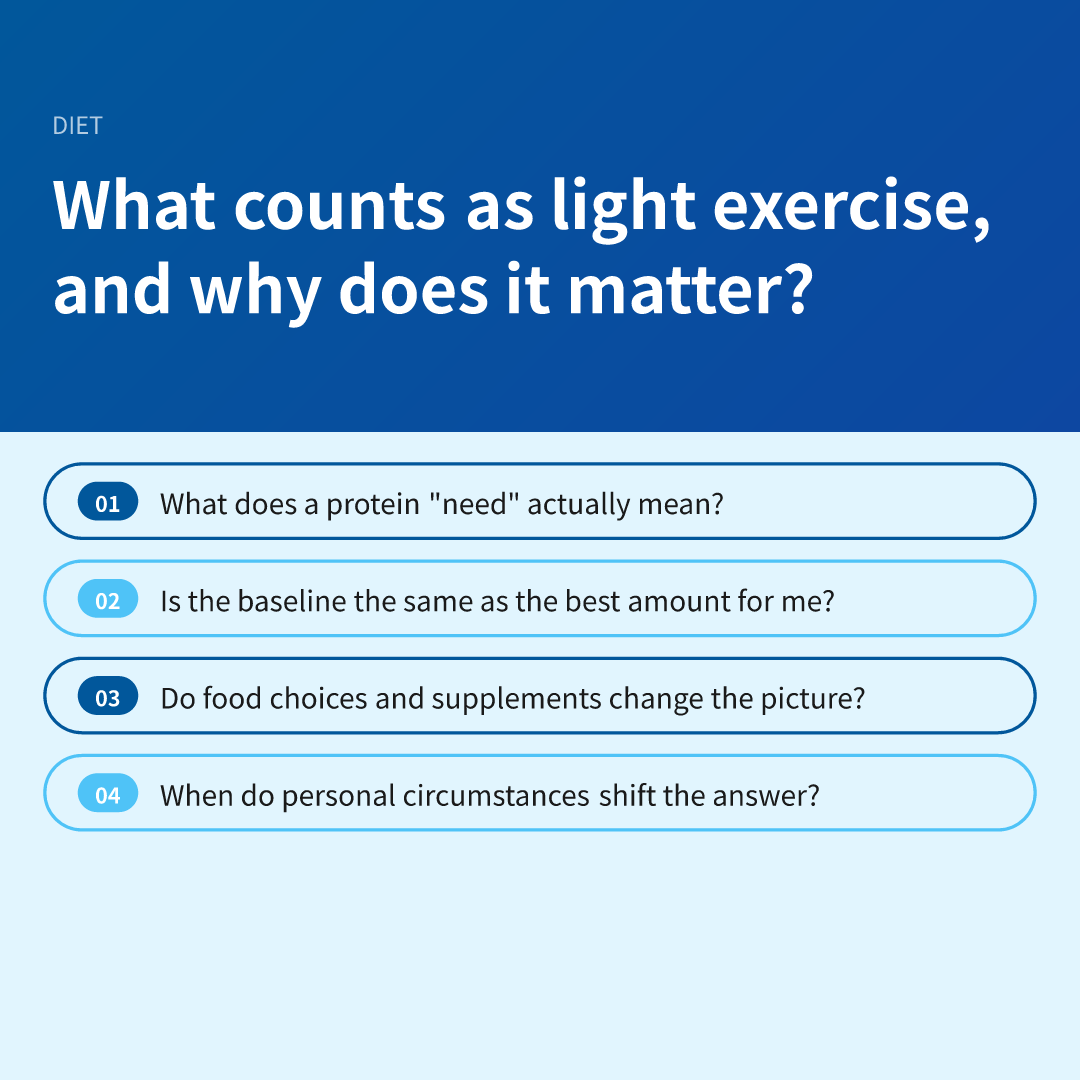
Light exercise is activity that raises your breathing a little while still letting you chat comfortably. Brisk walking, relaxed swimming, easy cycling, beginner yoga, and casual gardening all fit.
This matters because muscles that are not pushed hard create smaller repair demands. That is why people in this group often fit within the general baseline.
The exception is when your routine slowly becomes more demanding. Structured strength work or long endurance sessions move you toward sports nutrition territory, where the framing changes.
What does a protein “need” actually mean?
A protein need is an estimate, not a personal prescription. Protein is made of amino acids, which the body uses to repair tissue, make enzymes and hormones, and support immune function. Some of these, the essential ones, must come from food.
Official reference values are designed to cover most healthy people in a group, usually expressed relative to body weight. The U.S. Dietary Reference Intakes describe a Recommended Dietary Allowance, the level considered adequate for nearly all healthy individuals. You can explore the framework on the USDA Dietary Reference Intakes resource. (Source: MedlinePlus: Nutrition)
Two adults of the same weight can still do well on slightly different intakes. Age, health, and overall diet quality all play a part.
Is the baseline the same as the best amount for me?
Not necessarily. A reference intake is built to prevent shortfalls, not to name the ideal amount for every person.
Some researchers discuss higher intakes for goals such as preserving muscle during weight loss or in older age. The evidence on ideal amounts is still debated, so whether those ideas fit you is an individual question.
Athlete guidance is a related trap. Sports nutrition advice is written for demanding, regular training, so applying it to a few walks a week can lead to overestimating what you need.
A simple picture helps: a quiet house with minor wear needs a modest, steady supply of repair materials, while one under major renovation needs far more. Light exercise resembles the quiet house. It is only an analogy, since real bodies are more complicated.
Do food choices and supplements change the picture?
Yes, to a degree, but ordinary meals usually cover it. Many lightly active adults meet their needs without powders, bars, or shakes. Supplements are a convenience, not a requirement, and products vary in ingredients and quality, so reading labels is sensible.
Protein quality also matters. Eggs, dairy, fish, and poultry are usually described as complete sources. Many plant foods are lower in one or more essential amino acids, but eating variety across the day, such as beans with grains, is a common practical solution.
People following vegetarian or vegan patterns may want to plan a bit more deliberately. A dietitian can help.
One label tip: a 100-gram serving of chicken does not hold 100 grams of protein. The nutrition facts panel lists protein separately from food weight, and checking it clears up most confusion.
Rather than counting every gram, many people include a protein source at most meals, such as eggs, yogurt, fish, poultry, tofu, lentils, beans, nuts, or seeds, alongside plenty of plant foods. Related reading: How to Build a Balanced Plate When Your Meals Keep Falling Apart.
When do personal circumstances shift the answer?
Several life situations can move what makes sense for you, and each is best treated as a conversation with a professional rather than a rule.
With age, the body often becomes less efficient at using protein to maintain muscle, so older adults are often encouraged to pay closer attention at meals. Appetite, mobility, and kidney health all affect how much attention is reasonable.
Body size matters too, since guidance is tied to weight and a larger person generally has a larger total requirement. Pregnancy, breastfeeding, recovery from illness or surgery, and chronic conditions can change things as well.
Kidney disease is the key caution. Some people with reduced kidney function are advised to limit protein, so personal guidance outweighs any general average. The same goes for liver conditions or certain medications.
Falling short or overshooting both have downsides. Persistently low intake may show up as slower recovery, reduced muscle maintenance, or less satisfaction after meals, though these signs have many other causes. Eating far more than needed is not automatically harmful for many healthy adults, but it can crowd out vegetables, whole grains, and fruit, and it adds cost.
FAQ
Do I need a protein shake if I only walk and stretch?
Usually not. Regular meals with a protein source tend to cover the needs of lightly active adults. If you are curious about a specific product, a pharmacist or dietitian can review it with you.
Should I spread protein across the day or eat it all at once?
Spreading intake across meals is frequently mentioned as a practical pattern, and it tends to feel more natural than chasing a precise number. There is no need for rigid timing.
Who should get personal advice before changing protein intake?
A registered dietitian or primary care clinician can help if you have kidney disease, are pregnant or breastfeeding, are managing diabetes, are recovering from illness, have a history of disordered eating, or are older and noticing unintended weight loss.
Disclaimer: This article is for informational purposes only and is not a substitute for professional medical advice, diagnosis, or treatment. Please consult a licensed professional for personal health decisions.