Sleep Tracking Accuracy: What the Numbers Mean
Sleep tracking accuracy describes how closely a wearable, ring, or bedside device matches what is really happening in your body overnight. Most consumer trackers estimate sleep from movement and heart-related signals rather than measuring brain activity directly, so their numbers are best read as informed guesses. Below, you will find what the common metrics represent, when they hold up, where they tend to mislead, and how to put them to sensible use.
What Sleep Tracker Numbers Actually Represent
When your device shows a sleep score, a stage breakdown, or a total sleep time, it is producing an estimate. The device collects signals such as wrist or finger movement, heart rate, heart rate variability (the small changes in the time between heartbeats), and sometimes skin temperature or breathing patterns. Software then converts those signals into a guess about whether you were awake, in light sleep, in deep sleep, or in REM sleep (the stage linked with vivid dreaming).
The gold standard for measuring sleep is a polysomnography study, often called a sleep study. It records brain waves, eye movements, muscle activity, breathing, and more, usually in a sleep lab or under clinical supervision. According to the National Institutes of Health general guidance on sleep studies, this kind of testing is what clinicians use when they need to evaluate a suspected sleep disorder. Consumer devices do not record brain waves in the same way, which is the core reason their stage estimates carry more uncertainty.
Total sleep time versus sleep stages
Not all metrics are equally trustworthy. Many people find that total time asleep tends to be the steadiest estimate, because it mostly depends on telling "lying still and sleeping" apart from "awake." Stage labels, such as deep or REM, are harder to infer from the wrist or finger, so they are generally considered less dependable.
Scores and readiness ratings
A single sleep score, often out of 100, is a brand-specific blend of factors like duration, restfulness, and heart rate patterns. Each company weights those factors differently and does not always publish the formula. A score of 80 on one device may not mean the same as an 80 on another, so these ratings work better as personal trend markers than as universal grades.
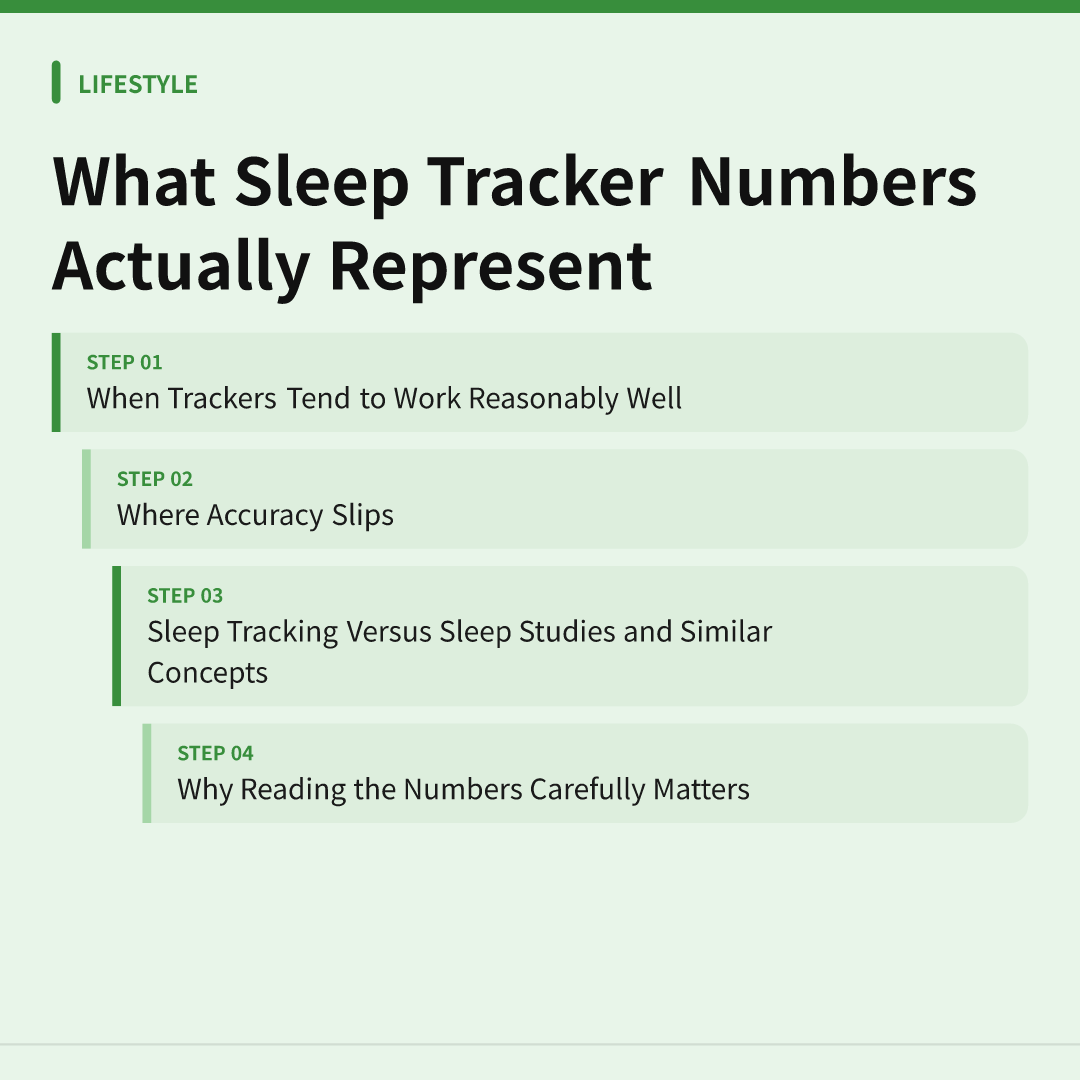
When Trackers Tend to Work Reasonably Well
Trackers are often most useful for spotting broad patterns over time. If your average bedtime keeps drifting later, or your estimated sleep time has dropped across several weeks, that pattern may reflect something real even if any single night is imperfect. Consistency matters more than any one reading.
They can also be helpful for noticing habits. Some people see that late caffeine, alcohol in the evening, or irregular schedules line up with restless-looking nights. That kind of observation can prompt a useful conversation with a pharmacist or healthcare professional, but a tracker is not able to confirm why a night went poorly.
- Good fit: noticing schedule consistency, rough sleep duration, and long-term direction of change.
- Weaker fit: judging exact minutes of deep or REM sleep, or comparing one night to another in fine detail.
- Not a fit: detecting or ruling out a sleep disorder or medical condition.
Where Accuracy Slips
Think of a tracker as a weather forecaster looking out one window. It sees some real signals, but it cannot see the whole sky, so it fills in the gaps with educated predictions. That is a fair picture of how most consumer devices handle sleep stages.
Several everyday factors can throw estimates off:
- Lying awake and still. If you are quietly awake in bed, a movement-based device may count that time as sleep. People with trouble falling asleep often notice their tracker seems more generous than they feel.
- Fit and placement. A loose band, a ring on a different finger, or cold hands can weaken the signal.
- Skin tone, tattoos, and wrist hair. Optical heart rate sensors can be affected by these factors, and performance may differ between people.
- Sharing a bed. A partner's or pet's movement can sometimes confuse devices that sense motion in the bed rather than on the body.
- Firmware updates. When a company changes its algorithm, your numbers may shift even though your sleep did not.
Because of these limits, general guidance from public health agencies tends to emphasize how you feel and function during the day. According to the Centers for Disease Control and Prevention (CDC) general sleep guidance, healthy sleep involves duration, quality, and regularity, and those are things a person can often judge partly by how rested they feel, not just by a device readout.
Sleep Tracking Versus Sleep Studies and Similar Concepts
It is easy to blur together several ideas that sound alike. Separating them can prevent a lot of unnecessary worry.
Tracking is not diagnosis
A wearable can show a pattern, but it cannot diagnose insomnia, sleep apnea (a condition in which breathing repeatedly pauses during sleep), or any other condition. Some devices offer features that flag possible breathing irregularities or unusual patterns. These are screening-style notices, not diagnoses, and a clinician would typically want to evaluate them with proper testing.
Sleep quality is not the same as sleep stages
People sometimes assume that more deep sleep or more REM automatically means better sleep. Stage proportions naturally vary between individuals, across ages, and from night to night. A tracker showing "low deep sleep" does not necessarily mean something is wrong, particularly when you feel fine during the day.
Readiness scores are not health scores
Some apps combine sleep with resting heart rate, temperature, and activity to produce a daily "readiness" or "recovery" number. These are wellness features designed to guide routine decisions, and they are not medical measurements. Treat them as a conversation starter with yourself rather than a verdict.
Why Reading the Numbers Carefully Matters
There is a real downside to over-trusting a score. Some people become anxious about their sleep numbers, and that worry can itself make it harder to fall asleep. Sleep specialists sometimes use the term orthosomnia to describe an unhealthy preoccupation with achieving perfect sleep data. It is not a formal diagnosis for everyone, but it is a useful reminder that a number can start to drive behavior in unhelpful ways.
The opposite problem also exists. A person who feels unrefreshed for weeks might dismiss it because their tracker shows "good" scores. Persistent daytime sleepiness, loud snoring with gasping or choking, or trouble staying awake while driving are the kinds of things worth raising with a healthcare professional regardless of what a device says. According to MedlinePlus general guidance, ongoing sleep problems that affect daily life are a reason to seek medical evaluation.
If you are curious about how to approach a tracker sensibly, here are some general habits people find helpful:
- Look at weekly or monthly trends rather than reacting to a single night.
- Pair the data with simple notes about how you felt, since your own experience is real information too.
- Stick with one device for comparisons, because switching brands changes the baseline.
- Consider taking breaks from checking the app if it starts to cause stress.
How Understanding Accuracy Changes Your Decisions
Knowing what these numbers can and cannot tell you shifts a couple of everyday judgments. Reasonable people can still disagree about how much to rely on wearables, and personal variation is large, so this is a framing rather than a rule.
- You can treat trends as useful and single nights as noise. A rough week of estimated sleep is a nudge to look at your schedule and habits, while one low score after a late dinner is not a reason to worry or to overhaul your routine.
- You can separate "interesting data" from "a reason to see a professional." Tracker patterns can inform a conversation, but ongoing exhaustion, breathing concerns during sleep, or significant changes in mood or alertness are better evaluated by a qualified clinician than by an app. In short, sleep tracking accuracy is good enough for noticing habits and not good enough for answering medical questions.
Disclaimer: This article is for informational purposes only and is not a substitute for professional medical advice, diagnosis, or treatment. Please consult a licensed professional for personal health decisions.
Related reading: How to Fix an Irregular Sleep Schedule Step by Step