A Simple Stretching Routine for Beginners: Key Terms Explained
A simple stretching routine for beginners usually means a short sequence of gentle, slow movements that take the major muscle groups through a comfortable range, done without pain and without forcing anything. Most people who feel stuck at the start are not short on exercises. They are tangled in vocabulary: static, dynamic, mobility, flexibility, "hold," "bounce," "warm up first." Once the words make sense, the decision about what to do gets much easier.
This article is written from an editor's point of view. It explains common terms in plain language, shows what they reveal about how a gentle routine is built, and offers questions you can bring to a physical therapist, trainer, or doctor. It does not diagnose anything or promise a particular result, because bodies, histories, and goals vary a lot.
Key terms to know before you start
Each term below follows the same pattern: the plain-language meaning, why it matters, and a common misunderstanding.
Static stretching
In plain words: you move into a position until you feel a mild pull, then stay there quietly rather than moving. A seated hamstring reach or a standing calf stretch are typical examples.
Why it matters: this is the style most beginners picture, and it tends to be the easiest to learn because the body is still. Many general fitness guides, including those from the National Institutes of Health and the CDC, describe stretching as one part of a well-rounded activity habit alongside aerobic and strength work.
Common misunderstanding: people assume a stronger pull means a better stretch. A mild, tolerable sensation is the usual target. Sharp, burning, or pinching feelings are a signal to back off.
Dynamic stretching
In plain words: controlled, flowing movement through a range of motion, such as slow arm circles, gentle leg swings, or easy torso rotations.
Why it matters: because you keep moving, it is often used as a lead-in to walking, jogging, or other activity. Some people find it feels more natural when their muscles are cold and stiff, such as first thing in the morning.
Common misunderstanding: dynamic does not mean fast or bouncy. Beginners sometimes swing a limb hard and call it a stretch. The movement should stay smooth and within a comfortable range.
Flexibility
In plain words: how far a muscle or group of muscles can lengthen, and how far a joint can move because of that.
Why it matters: flexibility is one of several ingredients of moving comfortably in daily life, such as reaching a high shelf or tying a shoe. It is not the same thing as strength or balance, and a person can be strong but tight, or flexible but unstable.
Common misunderstanding: flexibility is not a pass-or-fail test where touching your toes means success. Body proportions, joint shape, age, and activity history all influence range, so comparing yourself to someone else is rarely useful.
Mobility
In plain words: how well a joint moves actively through its range, using your own muscles to control it.
Why it matters: mobility blends flexibility with strength and control. That is why many beginner routines include gentle joint-focused moves, like shoulder rolls or hip circles, rather than only long holds.
Common misunderstanding: "mobility" and "flexibility" get used interchangeably online. They overlap, but they are not identical, so it helps to notice which one a program is actually training.
Range of motion
In plain words: the full path a joint can travel, for example how far your arm lifts overhead.
Why it matters: if a movement feels restricted on one side more than the other, or has changed recently, that detail is worth mentioning to a professional. It is more useful than saying "I am tight."
Common misunderstanding: more range is not always better. Some people have naturally loose joints and may need stability work more than extra stretching.
Warm-up
In plain words: a few minutes of easy movement, like walking or marching in place, that gets you slightly warmer before you stretch or exercise.
Why it matters: general exercise guidance often suggests easing into activity rather than starting cold. Warmer muscles typically feel more cooperative, though individual experience differs.
Common misunderstanding: a warm-up is not the same as stretching. Pulling hard on cold muscles is not what a warm-up means.
Hold time and repetitions
In plain words: hold time is how long you stay in one position, and repetitions are how many times you repeat it.
Why it matters: programs describe these differently, and the numbers you see online vary widely. Because needs differ by person, a physical therapist or certified trainer can tailor these details to your body and any conditions you have.
Common misunderstanding: longer or more is not automatically better. Comfort and consistency usually matter more than pushing duration.
Bouncing, or ballistic stretching
In plain words: using quick, jerky momentum to push deeper into a stretch.
Why it matters: many general guides advise beginners to avoid it, because forcing a muscle quickly can cause discomfort or strain for some people.
Common misunderstanding: bouncing is sometimes mistaken for "working harder." A calm, steady approach is generally what beginner resources describe.
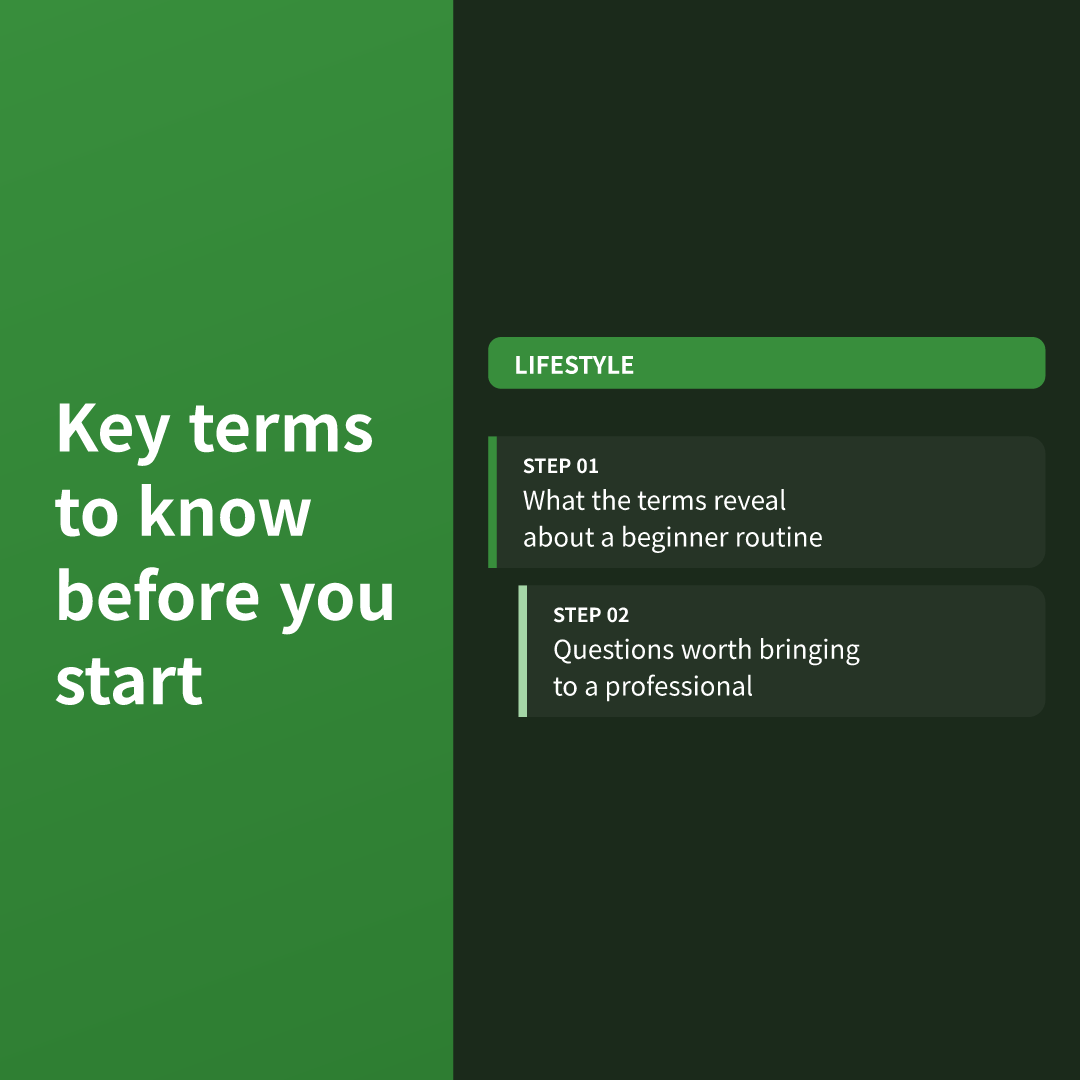
What the terms reveal about a beginner routine
Once the vocabulary is clear, the shape of a gentle routine becomes easier to see. Most beginner-friendly plans share a few traits, and none of them require special equipment.
- They start with easy movement. A short walk or gentle marching tends to come first, then dynamic moves, then quieter static holds.
- They cover the big areas. Neck and shoulders, chest, upper and lower back, hips, thighs, and calves are the usual regions, since these are where many people feel stiff after sitting or standing.
- They stay below pain. A mild pull is the common guidance. Pain, numbness, or tingling is a reason to stop.
- They keep breathing smooth. Holding your breath often adds tension, so relaxed, steady breathing is widely encouraged.
- They fit real life. A short session you can repeat often is usually easier to keep up than an ambitious one you abandon.
Related reading: Desk Stretches to Release Tension at Work: What Helps and Why
A typical beginner sequence, described in general terms, might move from a head-to-toe sweep: gentle neck tilts, shoulder rolls, a chest opener, a standing side bend, a hip flexor stretch, a hamstring reach, and a calf stretch. That is an illustration of structure, not a prescription. The exact choices, how long each lasts, and how often you do them depend on your comfort, schedule, and health, and a qualified professional can help you decide.
Who should be extra careful
Stretching is widely considered a gentle activity, but reactions vary from person to person. It is sensible to check with a doctor or physical therapist first if any of the following apply:
- You are recovering from an injury or surgery.
- You have joint conditions, osteoporosis, or a history of dislocations.
- You are pregnant, since body changes can affect joints and balance.
- You have ongoing pain, numbness, tingling, or dizziness.
- You have a heart, blood pressure, or balance condition.
Seek prompt medical care for sudden severe pain, swelling, a joint that looks out of shape, chest pain, or trouble breathing. Those are not stretching problems to work through on your own.
Questions worth bringing to a professional
Appointments go better when you arrive with specific questions. Here are some that translate the terms above into practical conversation.
- Given my health history, are there stretches or positions I should avoid?
- Would static or dynamic stretching suit me better right now, and when in my day?
- How can I tell the difference between a normal stretching sensation and a warning sign?
- Is my stiffness more about flexibility, strength, or joint movement?
- How should I adjust a routine if one side feels tighter than the other?
- What signs would mean I should pause and get checked?
- Can you watch me do a movement so I know my form is comfortable?
Bringing notes about when the stiffness shows up, such as after long sitting or after workouts, gives a professional far more to work with than a general complaint. If you prefer a guided approach, a licensed physical therapist or a certified fitness professional can demonstrate positions in person, which is something written articles cannot replace.
Frequently asked questions
Is it normal to feel nothing when I stretch?
Yes, it can be, especially in the early days or in areas that are already fairly loose. Some people feel only a faint sensation, and that does not mean you are doing it wrong. If you are unsure about your positioning, a trainer or physical therapist can check your form.
Why does one side feel tighter than the other?
Differences between sides are common, often reflecting daily habits like carrying a bag on one shoulder or favoring one leg. Most people have some asymmetry. If the difference is large, new, or comes with pain, it is worth mentioning to a healthcare professional.
I feel embarrassed about how stiff I am. Is that a problem?
No, and you are far from alone. Professionals meet people at every starting point, and stiffness is a very ordinary reason to ask for guidance. Starting where you are, without comparing yourself to anyone, is generally considered a sensible approach.
Do I need to stretch every muscle, or can I just pick the spots that bother me?
Many people begin with the areas that feel tight, and that is a reasonable place to start. General activity guidance tends to favor a balanced approach across the major muscle groups over time, though what suits you depends on your body and goals. A professional can help you prioritize.
A simple stretching routine for beginners comes down to understanding a handful of terms, moving gently within your comfort, and asking good questions when something feels unclear. Results differ between people, so patience and professional input are worth more than any single technique.
Disclaimer: This article is for informational purposes only and is not a substitute for professional medical advice, diagnosis, or treatment. Please consult a licensed professional for personal health decisions.