Daily Wellness Checklist for Busy Adults That Sticks
A daily wellness checklist for busy adults tends to work best when it is not a long list at all. Instead, each new action is attached to something you already do every day, a method often called habit stacking. The existing habit becomes the reminder, so you rely less on willpower and memory.
Most wellness plans fail for a boring reason: they ask you to carve out new time in a day that has none. A habit-linking approach skips that step by borrowing moments that already exist, like the minute the coffee brews or the pause before a meeting starts.
Below you will find ways to spot your anchor habits, pairing ideas for morning, work, and evening, and a plan for the days everything falls apart. Because they will. Building that in from the start is what keeps a routine going for months instead of a few enthusiastic days.
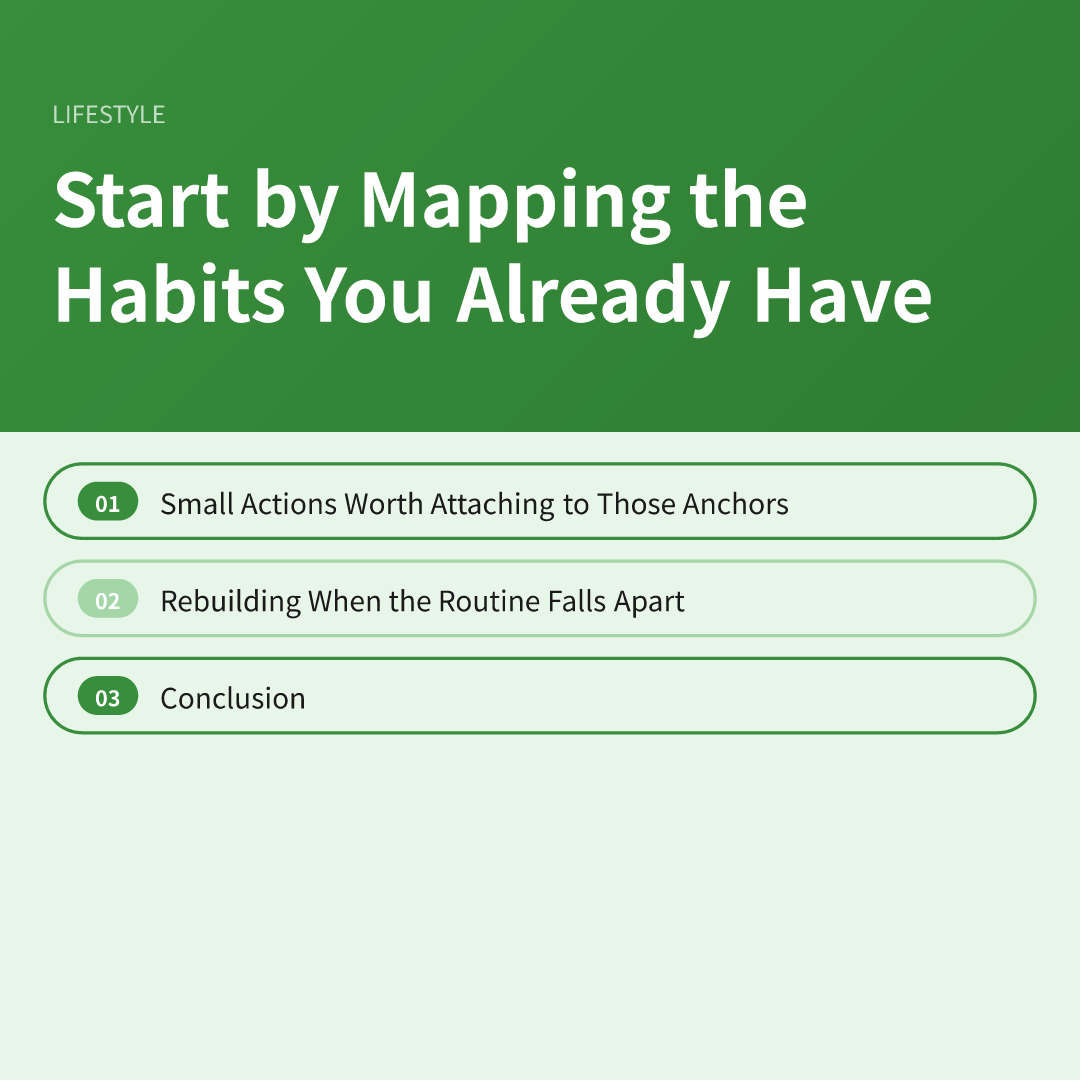
Start by Mapping the Habits You Already Have
Before adding anything, spend a day simply noticing what you already do without thinking. These automatic behaviors are your anchors, and the quality of the anchor matters more than the ambition of the new action.
What makes a good anchor
A useful anchor happens on most days, has a clear beginning, and takes place in roughly the same spot. “After I pour my coffee” is specific. “Sometime in the morning” is not, and vague anchors are the first to slip.
Timing also matters. An anchor that lands in a rushed window, such as the second you leave the house, can only hold a very small action. One that lands in a natural pause, like waiting for a kettle, can hold a little more.
Anchors many busy adults already have
Most people find they have more anchors than expected. Common ones include:
- Making the first coffee or tea of the day
- Brushing teeth morning and night
- Opening a laptop or logging into email
- Waiting for a video call to begin
- Sitting down for lunch
- Washing dishes or wiping the counter after dinner
- Plugging the phone in for the night
Pick three or four that feel truly automatic for you. If a habit only happens on some days, such as a gym visit, it makes a shaky anchor, so leave it off the list for now.
Related reading: How to Build a Simple Wellness Routine That Sticks
Small Actions Worth Attaching to Those Anchors
The pairings below are examples, not prescriptions. Wellness needs differ by age, health status, schedule, and personal history, so treat them as starting points to adjust.
Morning pairings
Coffee or tea plus a glass of water on the counter. Setting the glass beside the mug makes the second drink almost effortless. If a clinician has given you specific guidance about fluids, that guidance comes first.
Brushing teeth plus a few slow breaths. Many people find the bathroom is one of the few places where nobody interrupts them. A short pause to breathe slowly can work as a small reset before the day picks up speed.
Morning shower plus a quick check-in with your body. Notice whether your neck is tight, your jaw is clenched, or you slept badly. You are not diagnosing anything, just collecting information about how you feel so you can adjust the day.
Skincare steps you already follow plus a note to yourself. If a skincare routine is already part of your morning, it can carry a tiny extra like a one-line intention for the day. For product-specific steps, follow the label or ask a dermatologist or pharmacist.
Workday pairings
Opening the laptop plus naming one priority. Write a single sentence on a sticky note before opening email. It keeps the inbox from setting your agenda, which is a quiet kind of stress management.
Waiting for a call to start plus a shoulder roll or stretch. Those thirty seconds of dead time are easy to overlook. If you have pain, an injury, or a condition that affects movement, ask a qualified professional which movements suit you.
Sitting down for lunch plus screens away. Some people find that a meal without a screen makes it easier to notice hunger and fullness. Others eat at their desk anyway, and that is a common reality, so try it only on the days it is realistic.
Finishing a task plus standing up. Tying movement to the end of a task, rather than to the clock, feels less like an interruption. A short walk to refill your water works just as well as anything fancier.
Evening pairings
Washing dishes plus setting out tomorrow’s essentials. Bag, keys, and clothes laid out while the kitchen is already in motion can take a surprising amount of stress out of the next morning.
Plugging in the phone plus leaving it away from the bed. Charging the phone across the room turns a nightly chore into a boundary. Many people find it easier to wind down when the phone is not within arm’s reach.
Night-time tooth brushing plus dimmer lights. Lowering the lights as you brush signals to yourself that the day is closing. Sleep needs vary from person to person, so aim for a schedule that leaves you feeling rested rather than chasing a number.
Medication reminders. If you take prescribed medication, timing and amounts are set by your prescriber or pharmacist. Some people link a reminder to an existing habit, and a pharmacist can tell you which pairing fits your particular prescription.
How many pairings are too many
Start with one or two, not seven. The size of the new action should feel almost embarrassingly small, small enough that you could do it on your worst day. A tiny action done consistently tends to survive busy weeks better than an ambitious one done occasionally.
You can always grow a pairing later. Shrinking one after it has already collapsed feels like failure, while growing one feels like progress, even if the end result looks the same.
Rebuilding When the Routine Falls Apart
Plan for the breakdown before it arrives. A trip, a sick kid, a deadline crunch, or a bad week will interrupt any routine. What decides the outcome is usually the recovery, not the perfection.
Have a minimum version ready
For every pairing, decide in advance what the “bad day” version looks like. Two slow breaths instead of a full minute. A few sips of water instead of a full glass. One stretch instead of three.
The minimum version keeps the chain of behavior alive without demanding energy you do not have. It also protects the anchor, which is the part that takes time to build.
Try not to skip twice in a row
A common rule of thumb among people who work on habits is that one missed day is just life, but two in a row starts a new pattern. Nobody is policing this, so treat it as a gentle nudge rather than a strict rule. If you miss a day, go straight back to the minimum version the next time the anchor shows up.
And skip the guilt spiral. Making up for a missed day by doubling the next one usually backfires. Just resume at the normal size.
Re-anchor when life changes
Sometimes the problem is not you, it is the anchor. A new job, a new commute, or a change in who is home can make an old anchor disappear. If a pairing has failed for a week or so, look at whether the anchor still happens reliably.
If it does not, choose a new one rather than pushing harder. Swapping “after my morning coffee” for “when I sit down at my desk” is a design fix, not a personal failing.
When rest is the habit
During illness, injury, grief, or intense stress, the most useful adjustment may be to pause most pairings and rest. That is a legitimate choice, not a lapse. Restart with one small pairing when you feel ready.
Know the limits of a routine
Habit design can make daily life feel more manageable, but it does not diagnose or treat anything. Persistent fatigue, ongoing low mood, sleep trouble that does not settle, pain, or unexplained changes in how you feel are worth discussing with a qualified healthcare professional.
The same goes for anyone with a chronic condition, a pregnancy, an injury, a history of disordered eating, or a treatment plan already in place. Check with a professional before adding new exercise, food, or supplement habits, and let their advice override anything here.
Conclusion
A daily wellness checklist for busy adults does not have to be long, strict, or time-consuming. Pick anchors that already exist, attach actions that are almost too small to fail, and expect to wobble along the way. Results and preferences vary, so adjust each pairing until it fits your actual week and your own health needs.
Your first two weeks, in three rules:
- Choose one or two anchors and attach one tiny action to each, then leave everything else alone.
- On rough days, do the minimum version, and if you miss a day, restart at the next anchor without making up for it.
- At the end of week two, keep what fits, swap what does not, and bring any lingering health concerns to a qualified professional.
⚠️ Disclaimer: This article is for general information only and does not replace professional medical advice. Talk with a qualified healthcare provider about your own health, medications, and lifestyle changes.
Disclaimer: This article is for informational purposes only and is not a substitute for professional medical advice, diagnosis, or treatment. Please consult a licensed professional for personal health decisions.