How to Start a Health Journal Without Quitting
The most common way people try to learn how to start a health journal is by buying a beautiful notebook and promising to record everything: meals, sleep, mood, symptoms, steps, and water, every single day. It usually backfires. A page that demands too much becomes a chore, one missed day feels like failure, and the notebook ends up in a drawer. A health journal works better when it starts small, stays specific, and answers one question you actually care about.
Below, you will find the mistakes that most often derail a new tracking habit, what to do instead, how to adjust the idea to different situations, and answers to a few lingering questions. Nothing here replaces personal medical advice. Think of it as a practical guide to keeping useful notes about your own health.
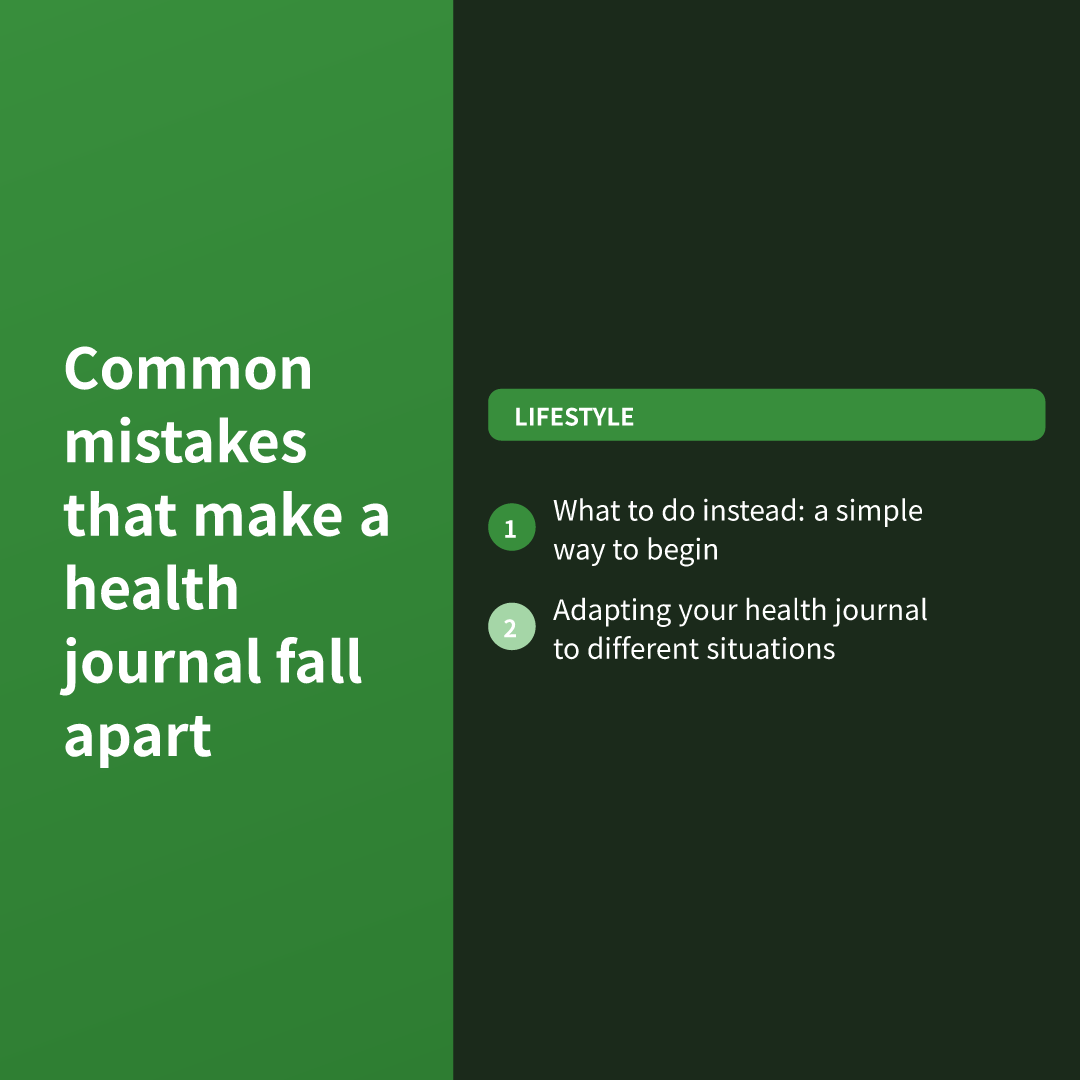
Common mistakes that make a health journal fall apart
Most abandoned journals fail for ordinary reasons, not a lack of willpower. The pattern is usually the same: the setup is too ambitious, the purpose is vague, and the reader gets little back for the effort. Each mistake below comes with the reason it tends to backfire and a simple alternative.
Mistake one: tracking everything at once
It is tempting to log food, sleep, exercise, mood, pain, energy, and hydration from day one. The trouble is that a long list turns a two-minute habit into a twenty-minute task, and people tend to drop habits that feel heavy. Too much data also makes it harder to spot anything meaningful later.
A better approach is to pick one or two things tied to a real question. If you are tired a lot, sleep timing and energy might be enough. If headaches are bothering you, the timing and circumstances of each episode may matter most.
Mistake two: writing without knowing why
A journal with no purpose is a diary of random facts. When you sit down a month later, you may not know what you were looking for, and the notes will not answer anything. This is one of the main reasons people feel their tracking "did nothing."
Instead, write a single sentence on the first page that names the goal. It might read, "I want to understand what makes my afternoons so sluggish," or "I want clearer notes to bring to my next check-up." That sentence guides every entry that follows.
Mistake three: aiming for perfect streaks
Many people treat a journal like a streak counter. Miss a day and the whole project feels ruined, so they quietly stop. Health patterns do not need perfect records to be useful; a handful of honest notes across several weeks often says more than a flawless record that lasts four days.
Allow gaps. If you skip a day, simply write the next entry and move on, perhaps adding "missed yesterday" so the gap is visible rather than hidden.
Mistake four: relying on memory at the end of the day
Waiting until bedtime to fill in everything sounds efficient, but details fade quickly. Sleepy, end-of-day entries tend to be vague, and people often reconstruct the day more neatly than it actually happened.
Try attaching a short note to a moment that already exists in your routine, such as after breakfast or while the kettle heats up. A few words written close to the event are usually more reliable than a long summary written hours later.
Mistake five: using the journal to judge yourself
Some people write entries like a report card, with harsh comments about what they ate or how little they moved. That tone can make the journal feel like a source of guilt, and people avoid things that make them feel bad. It can also push toward unhealthy preoccupation with numbers or food.
Keep the language neutral and descriptive. "Slept poorly, woke twice" is more useful, and kinder, than "Terrible night, my fault." If tracking food or weight ever starts to feel stressful or compulsive, that is a good moment to talk with a qualified professional rather than push on alone.
Mistake six: treating the journal as a way to self-diagnose
Notes can reveal patterns, but a pattern is not a diagnosis. Many different conditions can cause similar symptoms, and connecting the dots alone can lead to needless worry or false reassurance. A journal is better understood as a tool for clearer conversations, not a replacement for an evaluation.
Use your entries to describe what you notice, then let a clinician interpret it. That keeps the journal useful without asking it to do something it cannot.
What to do instead: a simple way to begin
Once the common traps are clear, the fix is mostly about shrinking the task and making it easy to repeat. The steps below are a general starting framework, not a medical program, and you can change any part of it.
Choose a format you will actually open
Paper, a notes app, a spreadsheet, and a voice memo can all work. The best format is the one that is already within reach. If your phone is always nearby, a notes app may beat a notebook that lives on a shelf. If you enjoy handwriting, a small notebook by the bed may feel more natural.
Many people also find that a simple, consistent layout helps. A date at the top and a few labeled lines are often enough.
Start with a tiny template
A short template removes the "what do I write?" problem. Something like the following is plenty for the first couple of weeks:
- Date and time of the entry.
- One main observation, such as sleep quality, energy level, or a symptom.
- Context, like what you were doing, eating, or feeling just before.
- One line of free text for anything that seems relevant.
Rating things on a simple personal scale, such as low, medium, or high, can be quicker than long descriptions. The scale only needs to make sense to you.
Tie it to a habit you already have
Habit researchers often describe linking a new behavior to an existing one, and many people find it easier to remember. Writing a quick note with your morning coffee or after brushing your teeth turns the journal into part of the day instead of an extra task.
Keep the first few weeks deliberately light. The aim at the start is consistency, not completeness.
Be specific about symptoms and timing
If you are tracking something that bothers you, specifics are what make notes useful later. Describe what it felt like in plain words, roughly when it started, how long it lasted, and what was happening around it. Vague notes like "felt off" are hard to use, while "tight feeling in my chest after climbing stairs, eased when I rested" gives a clinician something concrete to work with.
Include anything you are taking, including prescriptions, over-the-counter products, and supplements, as a factual list. Questions about whether to use, change, or stop any of them belong with a pharmacist or doctor, not in a do-it-yourself experiment.
Review on a schedule, not constantly
Checking your entries every day can make small fluctuations feel bigger than they are. A weekly or monthly look-back is often more informative. When you review, look for repeated themes rather than single bad days, and note questions to raise with a professional.
The MedlinePlus general guidance on preparing for appointments encourages people to bring a list of symptoms and questions, and a journal can be a natural source for that list.
Protect your privacy
Health notes are personal. If you use an app or cloud service, it is worth reading how it stores and shares information. Some people prefer a paper notebook for exactly this reason. Wherever you keep it, think about who might see it, especially on shared devices or in shared homes.
Adapting your health journal to different situations
There is no single right way to keep a journal. The structure that suits one person may be unhelpful for another, so it helps to shape it around your circumstances.
If you want to understand sleep or energy
Focus on a few consistent entries: roughly when you went to bed and woke, how rested you felt, and anything notable such as late caffeine, screens, stress, or an unusual schedule. According to general guidance from the CDC, sleep habits and routines can affect how people feel during the day, so patterns in these notes may be worth discussing if you are persistently tired. Needs and patterns differ from person to person.
If you are managing a long-term condition
People living with ongoing conditions are often asked by their care teams to track particular things, such as readings, symptoms, or triggers. In that case, the care team decides what to record and how often. Ask them what they want to see, and follow their guidance rather than inventing your own system. Your journal can then support, not replace, the plan you have been given.
If you are preparing for an appointment
A short run of focused notes before a visit can make the time with a clinician more productive. Write down when symptoms started, what makes them better or worse, what you have already tried, and your top questions. Appointments are often brief, and a one-page summary helps you cover what matters most.
If you want to build healthier habits
For general wellness goals such as moving more or eating more regularly, a journal can be a gentle prompt rather than a scorecard. Note what felt easy, what got in the way, and what you might adjust. Many people find that reflecting on obstacles is more useful than counting every detail.
If you have a medical condition, are pregnant, or take medication, talk with a qualified professional before making major changes to diet or activity.
If you are tracking mood or stress
Brief notes about mood, sleep, and stressful events can help you notice patterns. A journal is not a substitute for mental health care, though. If low mood, anxiety, or hopelessness is persistent or affecting daily life, reach out to a licensed professional. If you ever feel you might harm yourself, contact local emergency services or a crisis line right away.
When a journal is not the right tool
For some people, intense tracking increases worry or feeds unhealthy habits, particularly around food, weight, or body image. If you notice that logging makes you anxious, rigid, or distressed, it is reasonable to stop and speak with a healthcare professional. A tool meant to support well-being should not undermine it.
When to seek care instead of writing it down
A journal is for ordinary, ongoing observations. It is not a place to monitor warning signs while you wait. Severe chest pain, trouble breathing, sudden weakness, confusion, signs of a stroke, thoughts of self-harm, or any symptom that feels like an emergency calls for immediate medical help rather than another entry. For new, persistent, or worsening symptoms, contact a healthcare professional promptly.
Frequently asked questions
Is a health journal really worth the effort if I feel fine?
It can be, though it does not have to be elaborate. Some people use short notes to learn what their normal looks like, which can make changes easier to notice later. If it feels like a burden when you are well, a lighter version or an occasional check-in is a reasonable choice.
How long should I keep a journal before it becomes useful?
There is no set timeline, and it depends on what you are tracking. Patterns often become easier to see after a few weeks of fairly consistent notes, but a short, focused record can already help before an appointment. A clinician can tell you how much detail they would find helpful for your situation.
Can a journal replace wearable devices or medical tests?
No, because they do different jobs. A journal captures how you feel and the context around it, while devices and tests measure specific things, and neither one confirms a diagnosis on its own. Bring your notes to a professional who can decide which tests, if any, make sense for you.
Starting small is what makes a health journal last. Choose one question, keep the format simple, write in a neutral tone, and bring your notes to a qualified professional when something worries you. That is the whole answer to how to start a health journal that you will actually keep using.
Disclaimer: This article is for informational purposes only and is not a substitute for professional medical advice, diagnosis, or treatment. Please consult a licensed professional for personal health decisions.
Related reading: How to Make Walking a Daily Habit Without Burning Out